Micromobility Devices on Multiuse Trails
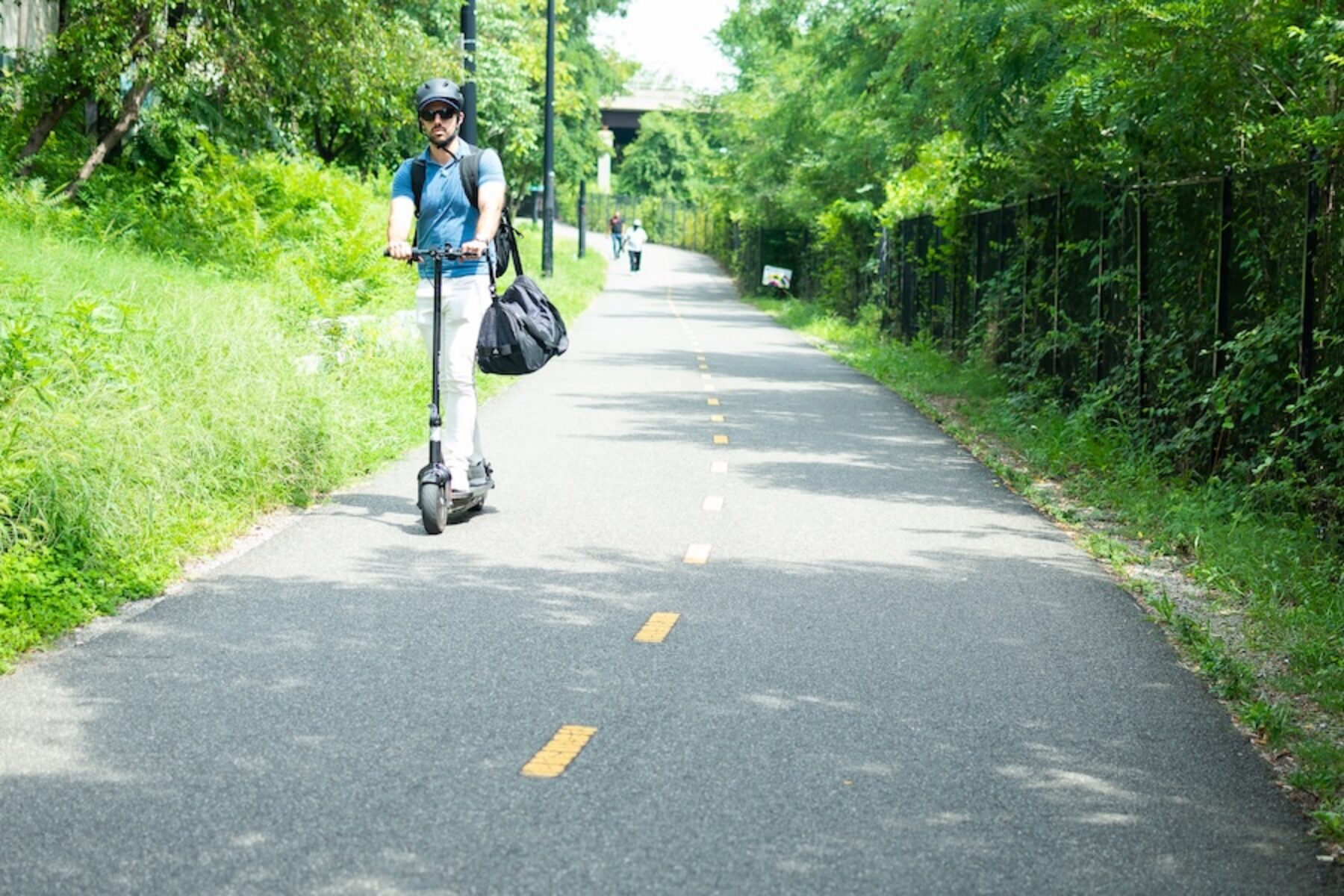
Micromobility has transformed how Americans move through their communities, including on multiuse trails. Personal and shared mobility options such as electric-assist bicycles (e-bikes) and e-scooters (scooters) are now common in all types of communities. Rails to Trails Conservancy offers the perspectives in this document to assist communities, trail managers and policymakers in making decisions about how best to manage these devices on nonmotorized multiuse trails.
Technology is rapidly evolving, and RTC has developed a criteria-driven approach to managing new technologies to prevent unsafe or stressful conditions while creating inclusive places. RTC’s recommendations seek to promote greater trail use—including increased diversity of people using trails—as well as safe and pleasant trail experiences by preventing and managing conflicts between types of trail use—objectives that at times may be in tension and require balancing by local jurisdictions.
The bottom line is that small, light, low-speed micromobility devices often can be operated safely on multiuse trails. Conventional bicycles have long shared trails amicably with pedestrians, wheelchairs and other people-powered devices. Micromobility devices that are similar to bicycles in terms of speed and mass typically do not violate the reasonable expectations of others on the trail to have a safe and low-stress experience.
The State of Micromobility
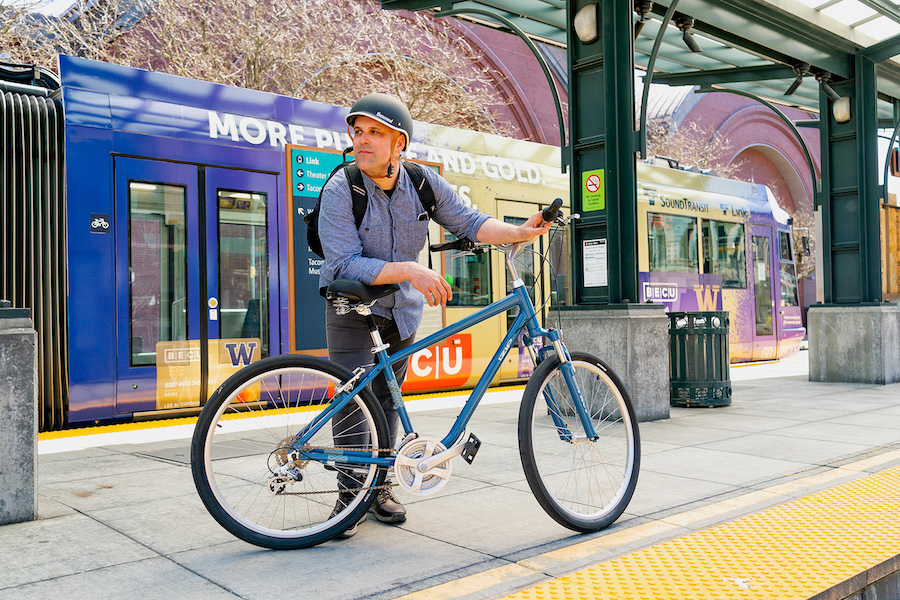
Currently, a range of micromobility technologies are in use as personally owned and shared devices in many communities nationwide. Their introduction to the marketplace can be swift—often with limited information about how and where the devices can or should be used. While RTC seeks to offer guidance to communities, trail managers and policymakers about these devices that will be flexible and evolve alongside the market, it is important to understand the context of the technologies that currently exist.
Current micromobility devices include e-bikes, scooters, e-skateboards and self-balancing devices.
E-bikes
E-bikes are a well-established form of micromobility that provides the leading edge of policy development. RTC supports the three-class system adopted by numerous states and the federal government that effectively enables a broader cross-section of society to get outside and be active, or to bicycle farther and over tougher terrain. Pedal assist e-bikes help to overcome limitations of ability and age, attracting more people to use trails more often. They also can facilitate greater utilitarian bicycling, such as grocery shopping or ferrying children.
Three-tiered E-bike Classification System
The vast majority of states have passed model e-bike legislation, creating a three-tiered e-bike classification system that differentiates between models with varying capabilities.
- Class 1: Pedal assist, under 20 mph
- Class 2: Throttle on demand, under 20 mph
- Class 3: Speed pedelec (pedal assist), under 28 mph
The default in many states is that Class 1 and Class 2 may operate on trails, and Class 3 may not. Local jurisdictions may override the default for classes 1, 2 and 3.
E-bikes are typically regulated as consumer products and specifically defined as not being “motor vehicles.” However, a minority of states treat all or some e-bikes as motorized vehicles.
E-motos
E-motos are faster, heavier and more powerful two-wheeled electric vehicles than e-bikes that have grown in popularity. E-motos are not considered e-bikes, because they can travel more than 20 mph on a throttle alone. They also exceed the power limit of e-bikes as defined in statutes (750 watts). E-motos may reach a top speed of 30–60 mph or more. While e-motos may look or appear like e-bikes because of their speed, mass, power and reliance on a throttle, they bear no functional resemblance to bicycles and are typically not considered to be micromobility devices. E-motos should be regulated as motor vehicles and strictly prohibited from use on multiuse trails. Motor vehicle regulation includes licensing, registration and insurance requirements.
Scooters
Scooters are a common form of micromobility, frequently available for shared use in urban environments, that operate by throttle. They are often used in bike lanes and on multiuse trails, with minimal conflicts where speeds are compatible. When used or stored on sidewalks, conflicts with pedestrians can be common.
Self-balancing devices
Self-balancing devices include electric skateboards, hoverboards and unicycles. Hoverboards are two-wheeled boards that generally operate at speeds ranging from 6 to 15 mph. Because Segways, another type of self-balancing device, were introduced in 2001, many states have regulations governing this category of devices. Regulations tend to be relatively permissive, allowing use on sidewalks and trails.
The Case for Inclusion
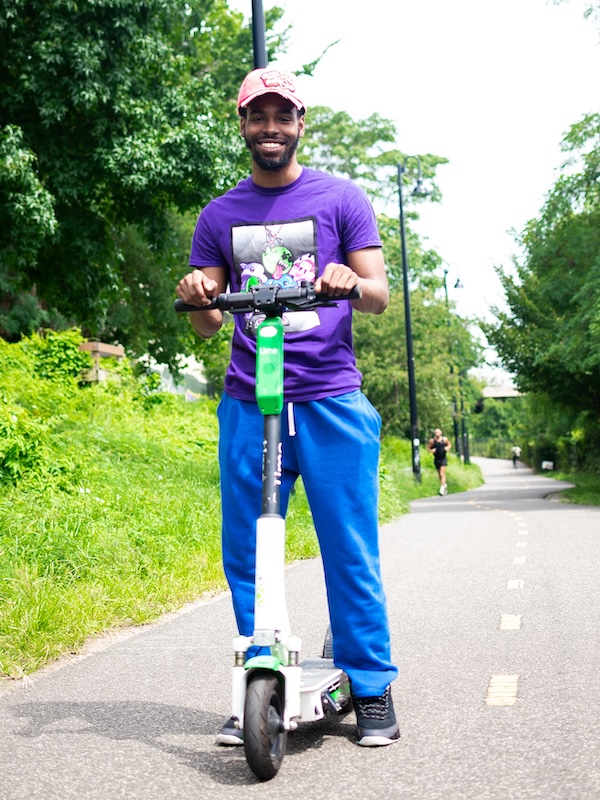
A typical multiuse trail serves pedestrians, bicyclists and people participating in other nonmotorized activities. Compared to sidewalks and bike lanes, the variability of uses and the culture of mutual accommodation offer opportunities to peaceably diversify the community of people on the trail. However, adding new, electric-powered devices into this mix could generate conflict if their characteristics or the way that they are used are not compatible with current uses.
Micromobility is a growing factor in urban mobility. In the United States, over half of all trips are 3 miles or less—trips that are ideal for micromobility use—and both shared and personal micromobility devices are often used for first- and last-mile connections to trains and buses. Micromobility use is growing and helping to mitigate urban traffic congestion. In 2024, at least 171 million shared micromobility trips were taken in the United States, a 31% increase from the previous year. This does not include trips made by privately owned devices. Proliferation and use of these technologies could grow enormously to the extent that they provide cheaper, faster and more convenient ways to make short trips.
RTC’s drive to attract a broad cross section of society to get outside and be active is fundamental to our work to ensure that trails are essential to communities. Rail-trails provide an accessible, safe outdoor experience featuring gentle grades without interference from car traffic.
Broadening of the micromobility market could expand the constituency for trails and other bicycle facilities. RTC supports e-bike use on trails—to the extent that the e-bikes fall into classes deemed appropriate for trail use following the legislative guidelines mentioned above. RTC’s perspective is that e-bikes ensure that biking is as inclusive as possible, especially in the context of aging adults and the needs of people living with disabilities. Scooters, hoverboards and powered skateboards are increasingly popular and appear to be drawing a younger, more diverse demographic, which could help increase trail use and diversify people using trails. The distance profile for scooters (1–2 miles) is shorter than bikes (2–4 miles), and many scooter users are not bicyclists.
RTC’s inclusionary leanings do not extend to e-motos or any other device that travels at speeds that are incompatible with other trail use. E-motos pose substantial safety risks, real and perceived, to other people on the trail, undercutting the purpose of the trail to provide a safe and accessible environment for people of all ages and abilities.
When technologies change, there is often an adjustment period for mobility providers, local governments, trail managers and the public. Rules, behavior and infrastructure may need to change to accommodate, with infrastructure requiring the most time and resources. Many people assume that they may use these devices virtually anywhere, but that is not sustainable given safety concerns. Infrastructure that can accommodate new users without endangering or inconveniencing existing users will be of increased value, in turn encouraging greater investment in creating and maintaining these resources.
The initial introduction of new technologies at scale can be chaotic. Responses appropriate to local context need to be devised for basic questions such as where to operate, how to behave and where to park such devices. The trails community—users and managers alike, policymakers and the public—together will need to learn and adjust expectations over time as pilot studies, research and overall experience advance.
Managing Shared Mobility on Trails: A Criteria-Driven Approach
While the reasons to accommodate micromobility technology on trails are many, new devices have raised substantial concerns about safe and pleasant interactions on trails based on speed, weight, size and behavior. Further, technologies will continue to evolve rapidly, and it will not be practical to make judgments entirely on a case-by-case basis in response to new devices or technological features as they are introduced to the market. This fluidity and juxtaposition of opportunity and risk are the foundation of RTC’s criteria-driven approach to managing micromobility on trails.
RTC’s interest is in creating and preserving safe and pleasant (low-stress) trail experiences that welcome a diverse community of people on the trail. This cues up five key criteria for policymakers and trail managers to use in deciding which devices to accommodate on multiuse trails or how to manage their presence. In considering these criteria, the comparability of new devices to bicycles is a valuable benchmark for compatibility on multiuse trails.
- Speed: Speed is fundamental to safety and stress, making it the single most important factor in determining trail compatibility. Speed influences both the likelihood of crashes and the degree of harm when they happen. It is sensible to define a dividing line of speed above which devices could be banned or regulated. Some small scooters are limited to standard urban bicycle speeds (10–15 mph) and should be accepted from the standpoint of safety and comparability. By contrast, devices outfitted (or retrofitted) with powerful batteries that can go well beyond fast road-bicycling speeds (20–25+ mph) pose a safety risk that warrant disallowing operation on trails. The five fastest scooters currently on the market are capable of 30–50+ mph, and e-motos may achieve top speeds of 30–60+ mph; all are incompatible with typical trail use, including people on foot, bicycles and wheelchairs. E-bike legislation that has been passed in most states often creates a default of allowing on trails bikes that are limited to 20 mph (Class 1) while disallowing those that are limited to 28 mph (Class 3). Local jurisdictions may override the default. RTC supports the e-bike policy and is open to extending the model approach to additional devices that are otherwise clearly comparable when evaluated against RTC’s five key criteria.
- Mass: Speed and mass combine to determine the strength of an impact. Together, these criteria determine the basic physics of safety risk. While weight is, in that sense, fundamental to safety, it is of lesser concern than speed because speed also increases the risk of crashes and stress for others on the trail. Scooters that are no heavier than a typical bicycle may be presumed not to pose a substantial new level of risk if traveling at trail-appropriate speeds. To increase stability, newer shared scooters weigh considerably more than the previous generation. A 40-pound scooter weighs more than a road or mountain bike but is on par with fully outfitted city or utility bikes (35–50 pounds), and weighs less than some dual-suspension or fat tire bikes (40–60 pounds), adult tricycles (45–73 pounds) and e-bikes (38–70 pounds). Excepting low-speed powered wheelchairs for persons with disabilities, which should continue to be allowed on all multiuse trails, RTC recommends that trail managers or policymakers with significant concerns about user conflicts consider a device weight limit of 75–100 pounds on trails to limit safety risks associated with device mass and, in the case of soft-surface trails, prevent damage to trails. Such a rule could specify that gear and/or trailers are not subject to the weight limit. Choosing 100 pounds would match the current federal e-bike definition.
- Width: Where devices are introduced that are wider than the objects that trails were designed to accommodate, it may become unsafe and/or stressful for people on the trail to pass one another. Local judgments about the acceptability of wider devices may vary based on the width of a trail, surface type and condition, and the volume and type of users (e.g., walking, bicycling, running, roller blading, etc.). RTC recommends that trail managers consider limiting device width, or adjusting trail width where desirable and feasible, to ensure that people may safely pass in either direction on the trail. Potential benchmarks for acceptable width of a device include standard wheelchair width (24–27 inches) or adult tricycle width (30–32 inches). Trail designers often look to the American Association of State Highway and Transportation Officials’ (AASHTO’s) design guidelines as the standard for multiuse trail widths. AASHTO recommends a minimum of 10 feet for multiuse trails; however, where heavy use is anticipated, a 12- to 14-foot width is recommended.
- Noise: People enjoy nonmotorized multiuse trails in part for the opportunity to be in a quiet place, to reduce stress and enjoy nature. The noise from internal combustion engines—such as those used in ATVs or motorcycles—is fundamentally incompatible with the desired trail experience. Current electric micromobility devices are quiet, and RTC is not aware of any user conflicts based on this factor. Absent introduction of a future technology that falls in between internal combustion engines and electric in terms of decibels, aside from snowmobiles where permitted, RTC recommends maintaining a simple prohibition on the use of internal combustion engines on nonmotorized multiuse trails.
- Pollution: As with noise, internal combustion engines are not compatible with nonmotorized trail uses because of the health impacts and unpleasant smell of fossil fuel emissions. A numerical standard is not necessary unless future technologies create gray areas between unacceptable internal combustion engines and acceptable electric motors.
Blending the Criteria
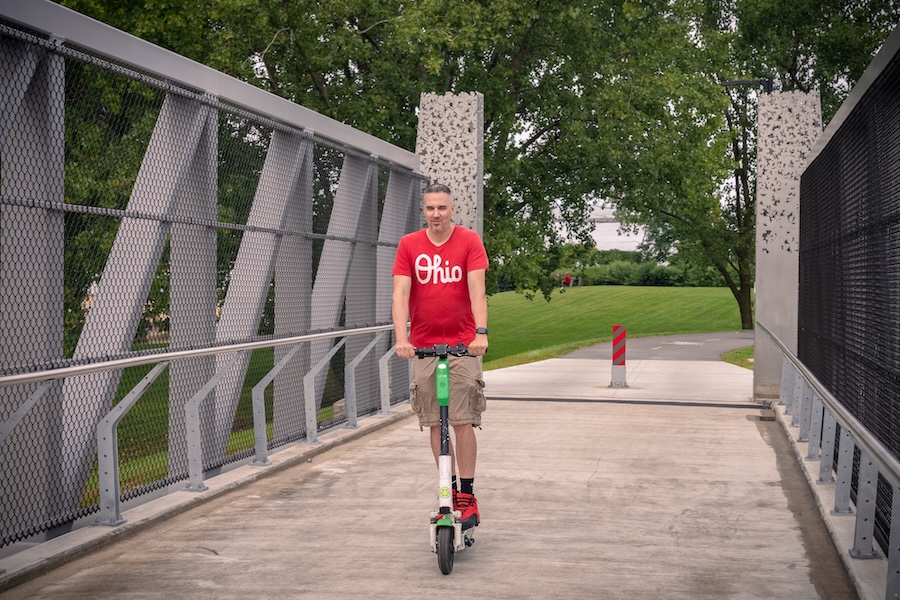
Any one of these factors—speed, mass, width, noise and pollution—alone could create concerns about using a particular device type on multiuse trails, but often it will be beneficial to look across the criteria to weigh the overall characteristics of a micromobility device against these factors. Trails should be inclusive and well used, but it is also critical to maintain a low-stress trail environment for people who need or value the opportunity to take refuge from cars or other faster, larger vehicles.
In determining the validity of the criteria in making informed decisions about the use of particular types of devices on nonmotorized multiuse trails, RTC analyzed several mobility devices across all five criteria, for example:
- All-terrain vehicles are incompatible with current nonmotorized trail uses against all five criteria—a clear case for a continued ban on nonmotorized trails.
- E-motos are incompatible with nonmotorized trail uses because of their excessive speed and mass.
- Scooters (shared electric kick-scooter style) are compatible with traditional trail uses provided that they remain no heavier than some utilitarian bicycles and their speed is limited to urban bicycle speed.
- Sit-down scooters (electric) pose variable compatibility considerations on multiuse trails, dependent on speed, size, mass and local trail conditions. A large sit-down scooter that can travel 30 mph and is intended for street use is too fast, heavy and large for multiuse trails. A small model that is limited to 20 mph and designed for bike lanes could be compatible, depending on local trail conditions.
Picking the Right Management Tools
An array of tools is available to manage risks posed by micromobility devices. Banning devices altogether is typically seen as an extreme response and is rarely used, except to respond to serious, widespread problems inherent to a product. Regulations can allow for a more nuanced response to the use of micromobility devices on trails.
Prohibiting the use of a device in certain places where it may be incompatible is more common. Conventional bicycles, for instance, are banned from crowded downtown sidewalks but not sidewalks along dangerous suburban arterials. The volume and type of trail use as well as trail design are critical context—best understood by local decision-makers—for determining how assertive managers must be to ensure a safe, low-stress trail experience. A paved urban trail used primarily for transit access and other utilitarian trips will likely find more reasons to accommodate scooters, as well as a greater need to regulate them for safety, than a rustic rural trail used primarily for recreation.
Scooters are currently used on busy sidewalks in many places, but policymakers increasingly are treating the practice as too dangerous for pedestrians. Scooters are more compatible with on-street bike facilities and, often, multiuse trails because there is an expectation that pedestrians will share that space with bicycles. If the inherent risk of a device is comparable to that of bicycles, there may be a presumption that its use on multiuse trails is appropriate, unless there are concerns beyond safety (e.g., noise).
Safety may be enhanced by providing warnings where trail conditions may provide challenges (e.g., uneven pavement). Further, behavioral norms or etiquette are a softer form of behavior management, but are often appropriate to conflicts between types of activites that occur on the trail.
Considering Behavior
Some people are concerned that an inclusive approach to micromobility devices based on technical compatibility criteria will not work because users of new technology have been observed to behave in a dangerous, unpredictable manner. Indeed, scooters have been associated with an increase in emergency room visits. New devices may create at least initial uncertainty about how users can and will behave. However, uncertainty and user conflicts may wane as familiarity with the devices grows, people gain skill in operating them, and providers of shared-service devices improve the safety of their products (e.g., increased wheel size) and invest in educating about proper use.
Yet, misbehavior is largely distinct from whether a device should be allowed to be used on multiuse trails. Crowded, narrow multiuse trails have long wrestled with user conflicts. Trail etiquette, enforced informally by people on the trail and reinforced with signage where education is needed, is often the most appropriate response. Broader public-education efforts, such as RTC’s Share the Trail campaign, also can help.
Formal enforcement is possible, but rarely practical, due to limited policing capacity and relative priorities. For example, the Capital Crescent Trail in Washington, D.C., and Maryland, with approximately 1 million users each year, has a legal speed limit of 15 mph to help in managing conflicts between road cyclists and slower users, but enforcement is essentially left to other individuals. The rule and signage give people using the trail standing to encourage safe speeds. Legal enforcement also may generate concern among groups that have experienced discriminatory enforcement practices. Some jurisdictions find it practical to identify and address dangerous misbehavior on streets between neighborhoods and trails because policing streets is routine.
Trail Design Solutions
RTC sees trail design solutions as potentially important elements in addressing how best to accommodate micromobility devices on trails—especially where new uses become common, trail corridors allow room and budgets can accommodate. For example, widening trails and separating uses physically or with paint are among the tactics that may be used. Design solutions may also help with concerns about parking, storage and the charging of devices. Best practices should be deployed to ensure trail accessibility.
Who Decides
Federal, state and local governments all will play a role in shaping the future of micromobility.
Federal law reserves multiuse trails for nonmotorized use for projects that use federal funds. If federal Transportation Enhancements funds were used to build a trail the use of “motor vehicles” on the trail is prohibited by law, with exceptions for trail maintenance, three classes of electric bicycles, motorized wheelchairs to facilitate access for persons with disabilities, and snowmobiles when state and local regulations permit. States often have their own laws which govern e-bike use on trails.
Transportation Alternatives funds allow eligibility for motorized projects under the Recreational Trails Program. However, if the original project proposal and the environmental documentation is only for a nonmotorized facility, then the project must remain a nonmotorized facility.
Congress enacted legislation in 2021 to exempt the three classes of e-bikes from the motorized prohibition for most federally funded trails, if state and local regulations permit. Motorized scooters and other micromobility devices are subject to the motorized prohibition for federally funded nonmotorized trails. However, for the Recreational Trails Program (RTP), the definition of “motorized recreation” only excludes motorized wheelchairs. Therefore, e-bikes and other micromobility devices are prohibited on nonmotorized trails built using funding from this program, but these devices may be allowed on RTP-funded motorized or mixed use trails.
Local governments are best placed to judge how local trail conditions might influence which devices or activities can co-exist with existing trail uses. Volume of use, trail width, surface conditions and the ratio of utilitarian, such as commuting, versus recreational use are examples of significant factors to consider. Localities may opt to restrict motorized access regardless of whether federal funds were used, but they cannot override outright federal or state prohibitions on their use. However, most state e-bike legislation merely creates a presumption and expressly enables local governments to reverse those defaults based on local conditions.

E-bike Stories
View more E-bike Blogs
How to Get to US World Cup 2026 Events by Trail, Walking, Biking and Public Transit

Trail Moments: Healing Through Nature Along Rail-Trails
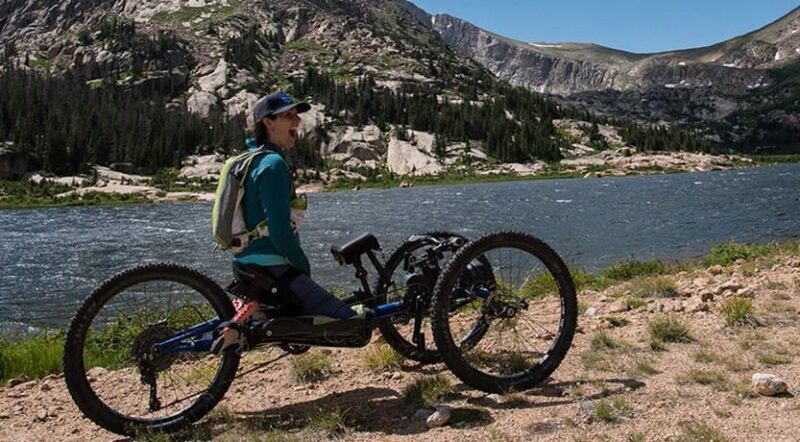
Trail Moments | Adventure for All: Advocating for Accessible Outdoor Spaces

Donate
Everyone deserves access to safe ways to walk, bike, and be active outdoors.
Related
View All Resources