North Carolina’s Downtown Greenway: November 2026 Trail of the Month
Just two months into her new job, Chelsea Phipps found herself donning a beekeeper’s suit. A skunk had scared off the residents of a hive located in Meeting Place Park, a pocket park off the Downtown Greenway in Greensboro, North Carolina, and a group of squatter bees had taken over. Tromping around alongside a group of volunteer beekeepers, Phipps worked to capture the new squatter queen and her followers so they could be relocated.
This task was admittedly unexpected for the City of Greensboro’s first greenway and gardens program coordinator. But before long, Phipps came to understand it was all in a day’s work for this role, newly created in 2022. This particular greenway, she would learn, was a lot more than just an asphalt path.
At the time of her queen hunting sojourn, roughly three-quarters of the greenway had been constructed, and she was hired to both get it across the finish line and manage it for the City of Greensboro. In May 2026, the Downtown Greenway—now spanning 4 miles—was officially completed, marking the end of a 25-year journey.
About the Trail
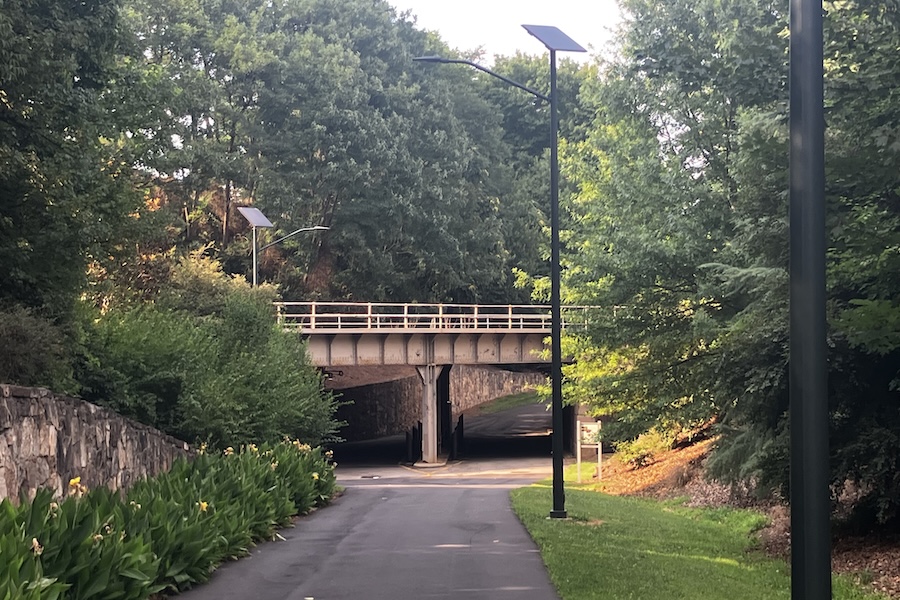
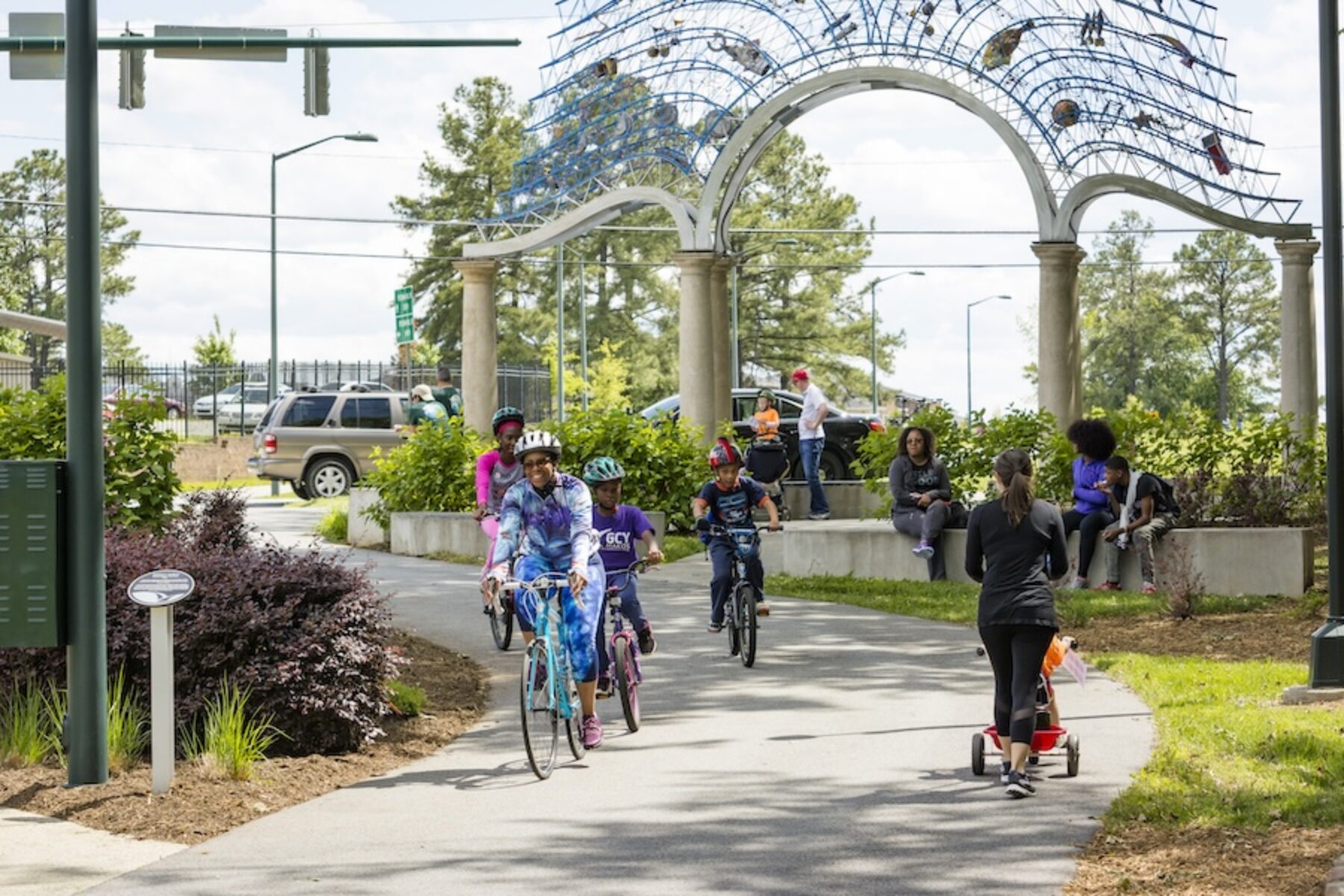
After a quarter-century in the works, Greensboro’s newly completed Downtown Greenway is serving as a vibrant connector between eight diverse neighborhoods. The 4-mile, paved pathway encircling the city provides new opportunities for economic development, access to recreation and nature, and a showcase for the community’s culture and heritage.
‘Beyond a Trail’
For the first time, downtown Greensboro residents have a seamless, nonmotorized connection to core city neighborhoods, including several that were subject to redlining. Additionally, the greenway has been the cornerstone of the city’s downtown revival strategy. According to Dabney Sanders, the greenway’s recently retired founding project manager, areas surrounding the loop have seen more than $612 million in completed and planned development, ranging from residential projects and offices to restaurants and entertainment venues.
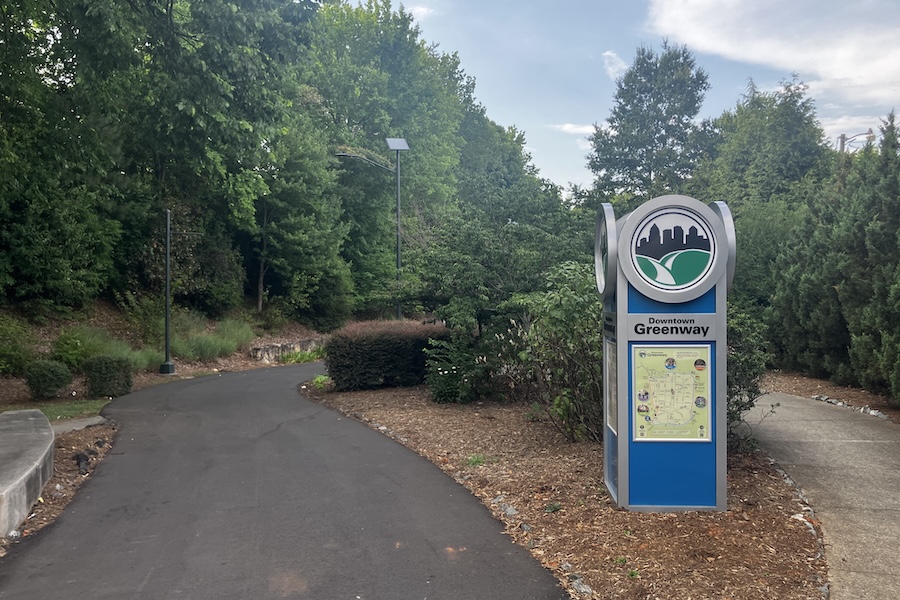
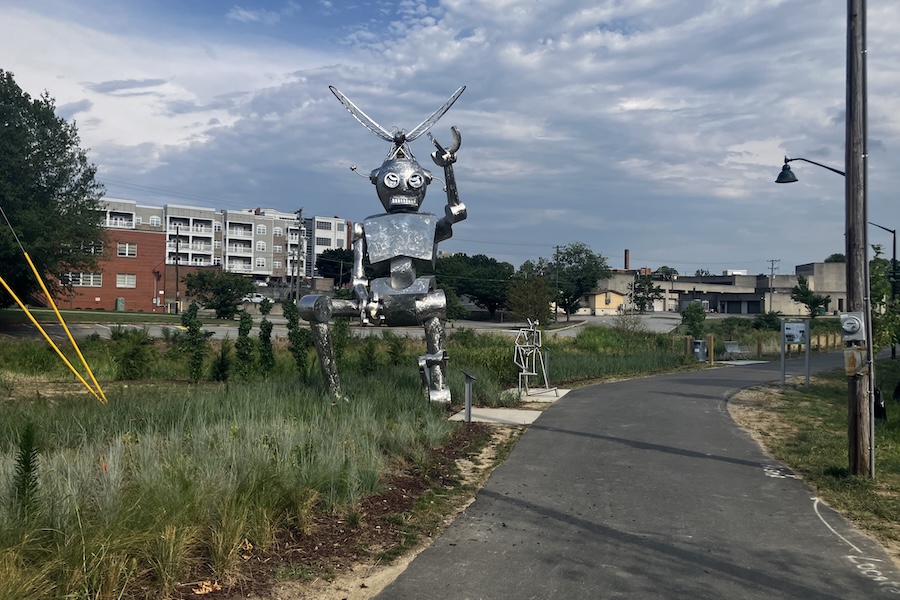
And then there are its cultural amenities: The greenway boasts more than 50 works of specially commissioned public art, several pocket parks and gardens (such as the one Phipps found herself playing beekeeper in), interpretive signage on the history of each of its eight city neighborhoods, and detailed wayfinding markers. The trail also hosts more than 180 programs and events a year—all free of charge.
“It’s an outdoor art gallery, it’s a history museum, it’s a botanical garden,” said Phipps. “It’s a lot of things beyond a trail.”
A Bold New Blueprint
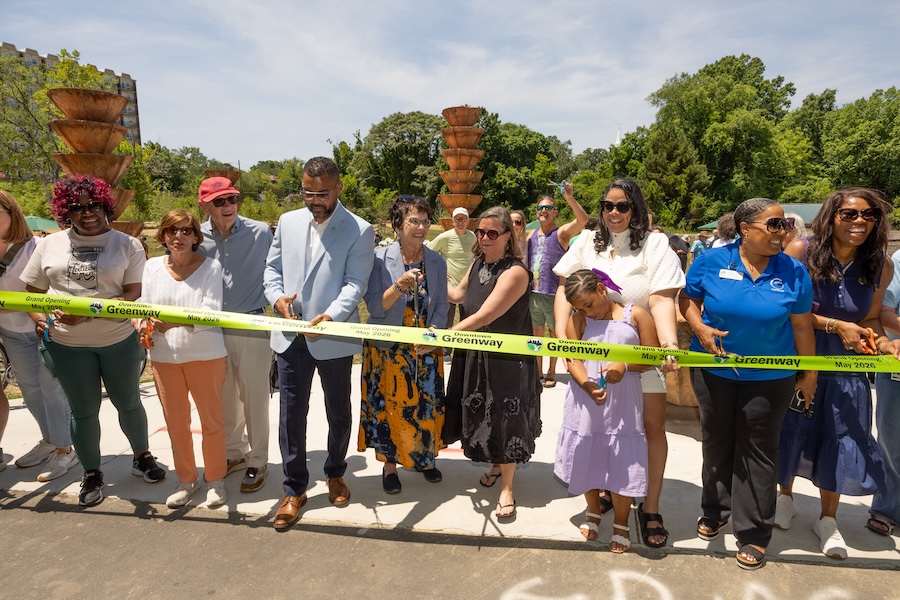
The first seeds of the greenway were sown in 2001, when Action Greensboro, a consortium of six local foundations, commissioned the Cooper Carry architecture firm to create a master plan for the city’s center.
By the late 1990s, Greensboro’s downtown was buffeted by a high vacancy rate and economic decline. As in many other U.S. cities, numerous businesses supporting the area’s traditional industries—most notably textile manufacturing—had either left or shrunk. Malls and shopping centers in the nearby suburbs added further economic pressure.
The intent was that a master plan could provide a new vision for downtown “that would hopefully change [its] trajectory,” said Sanders. As part of the drafting process, planners spent hundreds of hours talking with residents, businesses and organizations to understand how people envisioned the future of the city, and what they felt the city’s biggest strengths were.
One of Cooper Carry’s recommendations was to move the stadium for the city’s Minor League Baseball team, the Grasshoppers, closer to downtown, along with a performing arts venue. Additionally, they advised that these two major attractions, as well as other important city sites, should be connected via a 4-mile greenway loop that circumnavigated the city core. At each corner of the rectangular loop, public art influenced by the city’s history would be displayed.
“I loved that idea,” said Susan Schwartz, the director of Action Greensboro at the time. “Our board loved that idea. [Back] then it seemed rare, unique even, certainly for Greensboro and really the Southeast. It would link neighborhoods that abutted downtown, and that was something new to our thinking. It seemed like it might set us apart from other communities.”
‘Economic Development First and Foremost’
Initially, the city government’s response to the idea was “a little lukewarm,” according to Sanders, and the Greensboro Department of Transportation (GDOT) was “very, very skeptical of the project.”
Aggressive public outreach, led by Action Greensboro, became essential. “People couldn’t envision it, so you had to kind of spell it out for them,” said Schwartz. “The more renderings we had, the more we got people to understand it.”
From the beginning, Action Greensboro’s strategy was to frame the greenway primarily as a tool for accelerating economic development. “Recreation was, like, the bottom of the list,” said Phipps. “A lot of people think ‘greenway: run, walk, bike,’ but for [boosters] it was economic development first and foremost and adding to the complete and active transportation network.”
Schwartz credits two developments for moving the project forward. In 2004, the Cone Health Foundation, a local nonprofit (and member of Action Greensboro), donated $500,000 for a new bike and pedestrian plan for the city that included the greenway. Of note: The route included a section that went directly by the Grasshoppers’ new stadium, to which the team relocated in 2005. Then, around 2008, Greensboro College agreed to provide an easement for the project.
Local philanthropic organizations in Greensboro are unusually unified, explained Schwartz, helping them to have a greater impact once they identify a need—such as the new greenway anchoring downtown. “We have small foundations. We don’t have a lot of money, but we figured out in 2000 that we needed to work together,” she said.
Momentum picked up quickly. In 2007, Sanders was hired by Action Greensboro to manage the greenway project full time (project management officially transferred to the city this year). A year later, several local foundations, including The Cemala Foundation—of which Schwartz had become executive director—pledged more than $4.5 million toward the project. There was a catch, though: The funding would be released only if city voters approved a transportation bond that, in part, allocated $7 million toward the greenway. Action Greensboro launched a campaign to educate the public about the importance of this funding, and the measure passed with nearly 60% of the votes.
In 2009, the city broke ground on the first section of the greenway, and the quarter-mile segment opened the following year.
This article was published in the Fall 2026 issue of Rails to Trails magazine and has been reposted here in an edited format. Subscribe to read more articles about remarkable trails while also supporting our work.
A Key Driver for Change
Due to its urban setting, the Downtown Greenway faced several infrastructure challenges in its development. Sidewalks had to be expanded; sewer and utility lines had to be relocated; several roadways, including a former six-lane divided highway, were converted to a “road diet”; and intersections were drastically reconfigured. An old section of the former Atlantic & Yadkin (A&Y) Railway also needed to be incorporated into its western segment.
“Water, fire, police, planning—there are very few city departments that haven’t been a part of something to get it here,” said Phipps.
The good news is that the GDOT—once hesitant about the project—rallied strongly to the greenway’s cause, said Sanders, going to bat for it with North Carolina’s department of transportation and the federal government when additional funding was at stake. She credits the growing local and national enthusiasm for greenways and studies showing the benefits of “complete streets” for helping to get the GDOT onboard. She now considers the department “a really, really strong partner.”
Progress moved in fits and starts: A piece of greenway was built here, and then another there, and so on. But eventually, the gaps began to fill in—and neighbor hoods began to change.
A 6-acre parcel just off the greenway’s north-central segment offers a good example. The site of a Chevy dealership until the mid-2000s, it had few amenities or residents. In 2013, one of the owners of the parcel, Jim Jones, and his partners opened a new apartment complex on the site, directly along the greenway’s planned route. The developers were so eager to capitalize on the new path that they named their building after it: Greenway at Fisher Park.
That same year, the Deep Roots Market food co-op relocated two blocks northeast of the complex, making it the first grocery store in the downtown area in 30 years. This was a very deliberate choice, said Sanders. “They were committed to only looking at locations that were directly on the Downtown Greenway.”
Around 2015, Jones and his partners opened another apartment complex on the old dealership site, Greenway at Stadium Park, across the street from the Grasshoppers’ stadium, just a few blocks south of his other property. And in 2016, he and his family opened a brewery, Joymongers, a few blocks away, directly next to the greenway and LoFi Park, one of the pocket parks scattered across the greenway’s route. He said the elegantly landscaped green space, which attracts many families on weekends, was “a key driver” for his decision to put the business there.
Trailside Art to ‘Inform and Inspire’
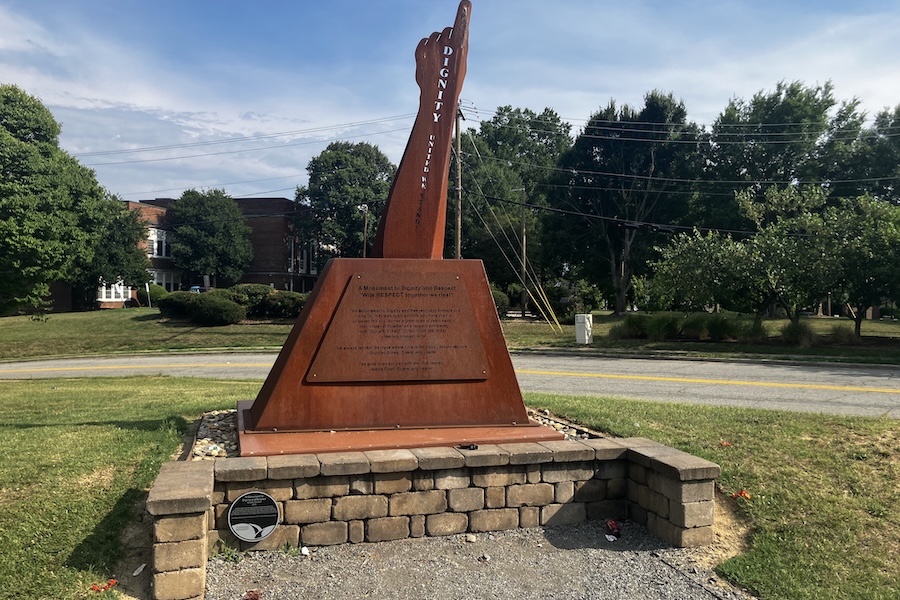
Arguably one of the Downtown Greenway’s most memorable features is its prolific display of public art. Over the course of its 4 miles, trailgoers encounter 50+ artworks commissioned by a City of Greensboro panel comprising local art museums, Creative Greensboro and several artists.
From the beginning, there was no intention to “buy something off the shelf from a gallery,” said Chelsea Phipps, Greensboro’s greenway and gardens program coordinator. As part of the application process, artists were required to describe their vision for their piece and its connection to one of the city’s neighborhoods.
Vandorn Hinnant, a Raleigh-based sculptor who grew up in Greensboro’s Ole Asheboro neighborhood, exemplifies these connections. His work, “A Monument to Human Dignity and Respect,” is displayed along the trail within Ole Asheboro. Comprising two pieces, each half of the sculpture depicts an oversized arm and hand rising to the sky at an angle, its pointer finger raised. Below, quotes from Black community leaders Nettie Coad and Dorothy Brown are inscribed. Hinnant chose to sculpt with Cor-Ten steel, he said, because when it oxidizes it turns brown, and the works were meant “to represent people of African ancestry.”
“My role in this process was to make a comment related to the Civil Rights Movement and human rights movement,” said Hinnant. “I am an educator. And my work wants to serve that purpose: to inform and inspire individuals.”
It’s a fitting mission given the city’s historic place in the Civil Rights Movement. In February 1960, four Black students from the nearby North Carolina Agricultural and Technical College staged a sit-in at the nearby downtown Woolworth’s, sparking a wave of student-led, anti-segregation protests across the South. Today, that Woolworth’s houses the International Civil Rights Center & Museum.
Worth the Wait
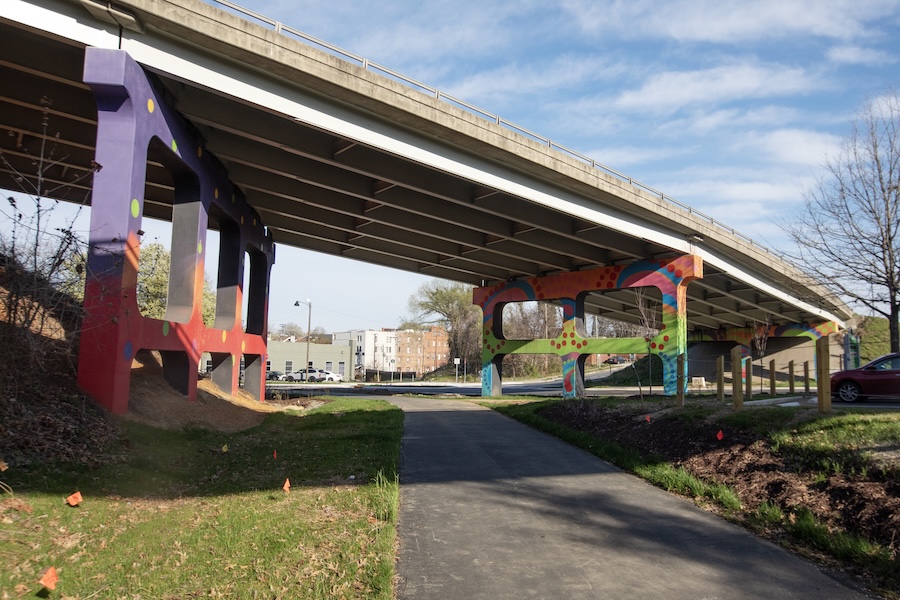
In 2025, the greenway recorded over 150,000 users, a figure that’s anticipated to increase now that the trail is a fully contiguous loop. One of these newer users is Jake Esposito, who lives in the Westerwood neighborhood, just blocks from the final section of greenway—the former A&Y Railway section—that was completed this past May.
Since it opened, he’s been using it to bike to work almost every day. “It’s been easy for me just to ride down my road and hop on the greenway and go right into downtown.” He describes the greenway as beautiful, but more importantly to him, commuting on it feels much safer than on the road.
There’s even better news ahead for trail enthusiasts such as Esposito: According to Phipps, the GDOT is currently halfway through a design for a 2.5-mile connection to the Atlantic & Yadkin Greenway, the city’s first rail-trail. The connector’s completion is expected by summer 2029, with the new linkage opening up access to the scenic, nearly 8-mile route heading northwest out of the city through pine and hardwood forests to Lake Brandt.
After more than two decades of waiting, city officials, local leaders and residents couldn’t be more delighted with their new greenway. It has, its backers believe, helped spur an economic and cultural revival downtown that is only just beginning. With $54 million invested in its construction to date, the project already represents an estimated return of more than $11 for every dollar spent.
“We have this little saying now that we thought it would set Greensboro apart from other communities, which it has done—but it has also brought us together,” said Schwartz. “It’s more than a place for wellness and fitness and transportation. It tells a story about us.”
Related Links
Trail Facts
Name: Downtown Greenway
Used railroad corridor: The western segment of the trail utilizes the former Atlantic & Yadkin (A&Y) Railway corridor.
Trail website: Downtown Greenway
Length: 4 miles
County: Guilford
Start point/end point: The trail is a loop; a good place to begin your journey is at the Morehead Park trailhead (475 Spring Garden St.) on the trail’s southwestern section. From there, you could take the trail clockwise or counterclockwise back to the start.
Surface type: Asphalt, concrete
Grade: The trail is relatively flat with only an elevation gain of about 150 feet across its 4 miles.
Uses: Walking, bicycling and inline skating; wheelchair accessible
Difficulty: With its paved surface and relatively level grade, the trail is considered easy for most trail goers.
Getting there: The closest airport to the Downtown Greenway is Piedmont Triad International Airport (1000 Ted Johnson Pkwy., Greensboro), about 8 miles west of the trail. Visitors can also arrive via Amtrak at the J. Douglas Galyon Depot (236 East Washington St.), located in downtown Greensboro about a half-mile from the trail.
Access and parking: Parking is available on the southwestern loop of the trail at Morehead Park (475 Spring Garden St.) and at a small parking lot at the intersection of S. Eugene St. and JC Lane. Another parking lot is available on the southeastern loop of the trail along Plott Street, just south of Gorrell Street.
To navigate the area with an interactive GIS map, and to see more photos, user reviews and ratings, plus loads of other trip-planning information, visit TrailLink, the official trail-finder website and app of Rails to Trails Conservancy.
Rentals: Revolution Cycles (1907 Spring Garden St.; 336.852.3972) provides bike rentals 2.4 miles west of the Downtown Greenway’s Morehead Park trailhead (475 Spring Garden St.). Greensboro also offers a bike-share program through Bird Rides Inc., which operates across downtown.
Donate
Everyone deserves access to safe ways to walk, bike, and be active outdoors.
Related
View All
Trail Moments: A Couple Rides 50 Miles in 50 States
Illinois’ Bloomingdale Trail: October 2026 Trail of the Month