Revisiting a Landmark Supreme Court Case for Trails: Preseault v. Interstate Commerce Commission
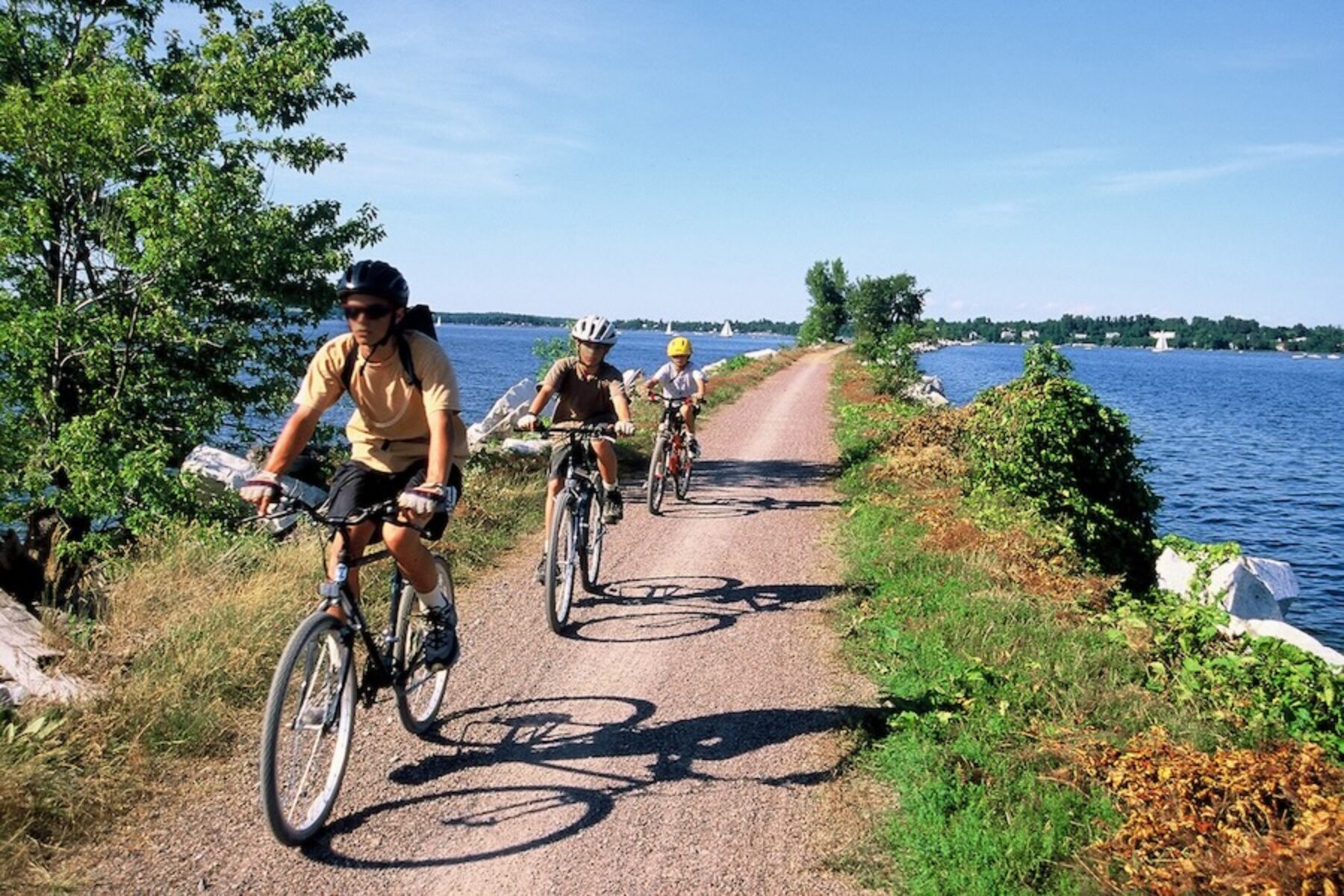
In 1990, a Landmark Supreme Court Ruling Helped Shape the Future of Trails.
Since being signed into law in 1983, railbanking has been used to create 265 rail-trails (and counting), but the process to implement the law has not always been straightforward. Early on, legal challenges mounted—from efforts to block the state-spanning Katy Trail in Missouri to parcel-by-parcel fights across the country. Then in the late 1980s, a legal challenge over efforts to railbank Vermont’s future Island Line Trail would go all the way to the U.S. Supreme Court.
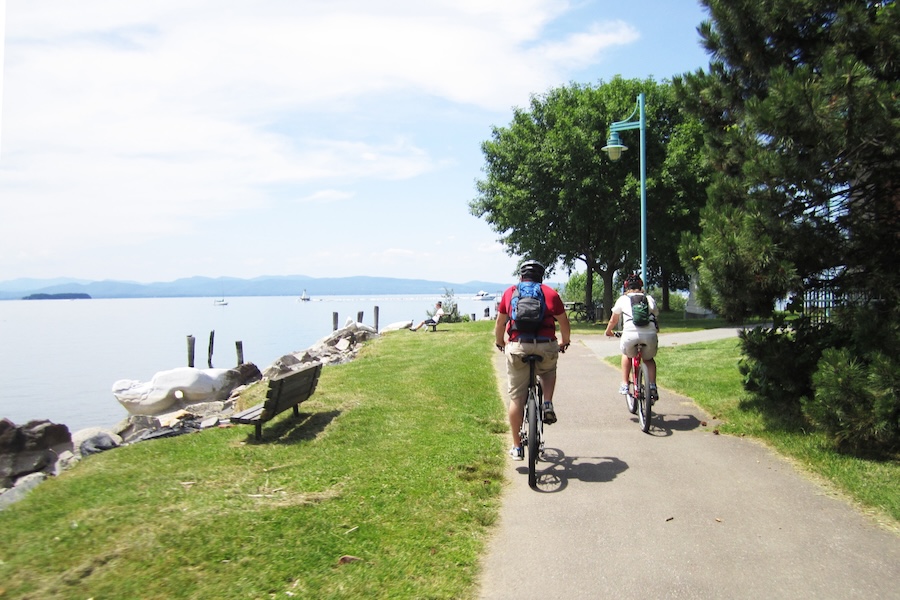
A member of the RTC Hall of Fame, Vermont’s Island Line Trail—whose corridor was the subject of the Supreme Court Case Preseault v. ICC—today features 13 miles of expansive lake views between South Hero and Burlington.
Railbanking Act Is Passed
Dismayed to see active railways disappearing at a precipitous rate, Congress sought a way to preserve disused railroad corridors, keeping intact the transportation infrastructure for future use through interim use as trails—creating human-powered recreation and transportation pathways.
In 1983, the National Trails Systems Act was amended to enshrine the concept of railbanking into law, establishing a way that railroad corridors could be repurposed into trails once they no longer carried trains. Conceptualized by then-Department of Interior staffer Pete Raynor, section 8(d)—colloquially known as the Railbanking Act—paved the way for rail-trail conversions.
While the idea seems straightforward, the complexity of property ownership is significant. If a railway owns outright the land on which its trains run, donating or selling it in whole to a state agency or trails group once it’s no longer needed is relatively simple, explained Andrea Ferster, Rails to Trails Conservancy’s longtime general counsel—but that, she said, is rarely the case. Instead, most railways traditionally relied on a dizzying matrix of owned parcels, easements and leases for corridors that could run for hundreds of miles past potentially thousands of landowners.
“Most railroads acquired their corridors well over 100 years ago, some of them in the 19th century—and you can imagine that the acquisition strategies would vary depending on the railroad, the jurisdiction, the landowner,” said Ferster. Rather than purchasing land, railways “often acquired a simple right-of-way, and what that means in terms of property law depends on how each state interpreted it.” In many cases, the federal government subsidized the land acquisition, and public dollars were used to build the railroads in the public interest.
For any group looking to purchase a railroad corridor for trail use, that patchwork nature makes “trying to research [the ownership] of a railroad corridor confusing and complicated. It’s a nightmare of a property law exam,” she quipped. The Railbanking Act of 1983 fundamentally changed this calculus, simplifying the process of preserving—and repurposing—a corridor in its entirety and keeping it in the public domain.
“Foundational is a good word to describe it,” said Ferster.
While rail-trail conversions existed before the law was passed (well-known examples include the Illinois Prairie Path and Wisconsin’s Elroy-Sparta State Trail, both created in the 1960s), they were few and far between.
Railbanking created a more feasible opportunity for civic leaders and activists to pursue rail-trail development and their benefits.
RTC’s first general counsel, Charles Montange, noted, “Before the railbanking statute, it was almost impossible for a private party to make a rail-trail. Almost impossible.” By allowing a rail line operator to railbank an entire corridor, preserving it for use as a rail-trail became much more viable.
That viability quickly became apparent as the Iowa Trails Council (now Iowa Natural Heritage Foundation) submitted the first railbanking application for the 33-mile Sauk Rail-Trail in 1984.
This article was originally developed for the Spring/Summer 2026 issue of Rails to Trails magazine and has been reposted here in an edited format. Subscribe to read more articles about remarkable trails while also supporting our work.
Legal Battles Create Challenges
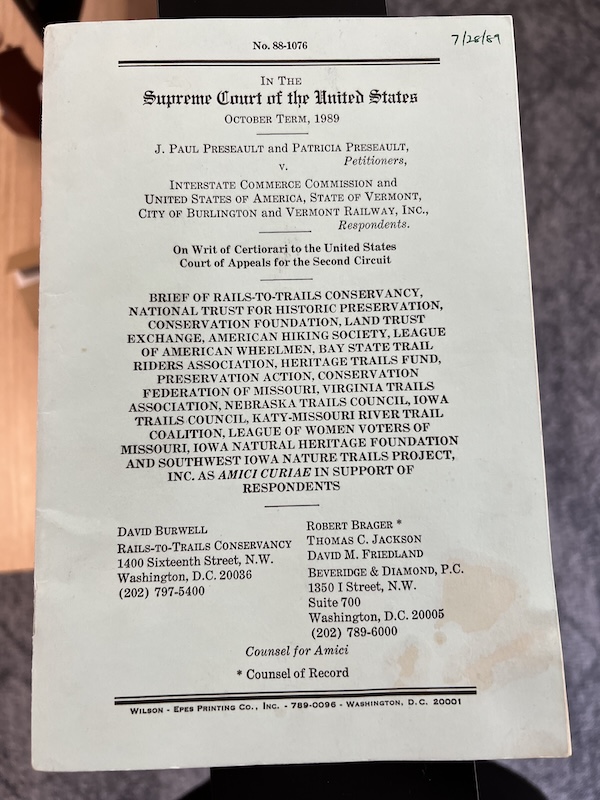
J. Paul and Patricia Preseault owned land near Lake Champlain, where trains of the Vermont Railway once thundered past on a right-of-way granted to the railway by a long-ago property owner in 1899. The Preseaults were aware of the right-of-way when they purchased the property, but when railway operations ceased in the 1960s, they believed it would terminate and the land would revert to them. When the Island Line Trail started development instead, the Preseaults sued the Interstate Commerce Commission (ICC), challenging its authority over disused railway corridors—and ultimately the very constitutionality of the Railbanking Act.
As Preseault v. ICC was wending its way through the courts, so too was Glosemeyer v. Missouri-Kansas-Texas Railroad, which involved Missouri’s 240-mile Katy Trail. “RTC was heavily involved in Glosemeyer from the inception,” said Montange, and “had the primary role in formulating the legal strategy.”
Montange delivered successful oral arguments in support of railbanking at the Court of Appeals for the Eighth Circuit and won the case. When the U.S. Supreme Court took up the Preseault case, RTC and the National Trust for Historic Preservation filed an amicus curiae (Latin for “friend of the court”) brief to inform the justices’ understanding of the issue. “The legal theory upon which the Supremes upheld the constitutionality of the Trails Act was the theory on which the Eighth Circuit relied, so one could say that Glosemeyer resolved Preseault,” explained Montange.
Indeed, in 1990, the Supreme Court unanimously upheld railbanking as a valid exercise of congressional power under the Constitution’s Commerce Clause. They wrote, “Congress apparently believed that every line is a potentially valuable national asset that merits preservation even if no future rail use for it is currently foreseeable.”
RTC co-founder David Burwell noted the significance of the win in a 2008 interview for Rails to Trails magazine, saying, “The Supreme Court case marked the change in public policy from letting railroads abandon their tracks to a recognition nationally that they need to be preserved, whether for rail-trail use or not.”
While the constitutionality of railbanking was definitively decided, the court battles didn’t end. The Preseaults filed another lawsuit asking the courts to decide whether the land was taken from them without just compensation. While RTC vigorously opposed this suit, fearing it would open the floodgates to landowner compensation claims, the Preseaults were ultimately successful, with a deeply divided federal appellate court deciding in 1996 for Preseault v. United States that the landowners were owed compensation, which would come from federal coffers. Compensation, however, was the sole remedy; the trail’s use could not be halted or disrupted.
“In the old days, before the railbanking statute, it was almost impossible for a private party to make a rail-trail.”
—Charles Montange, RTC’s first general counsel
A Champion for Railbanking
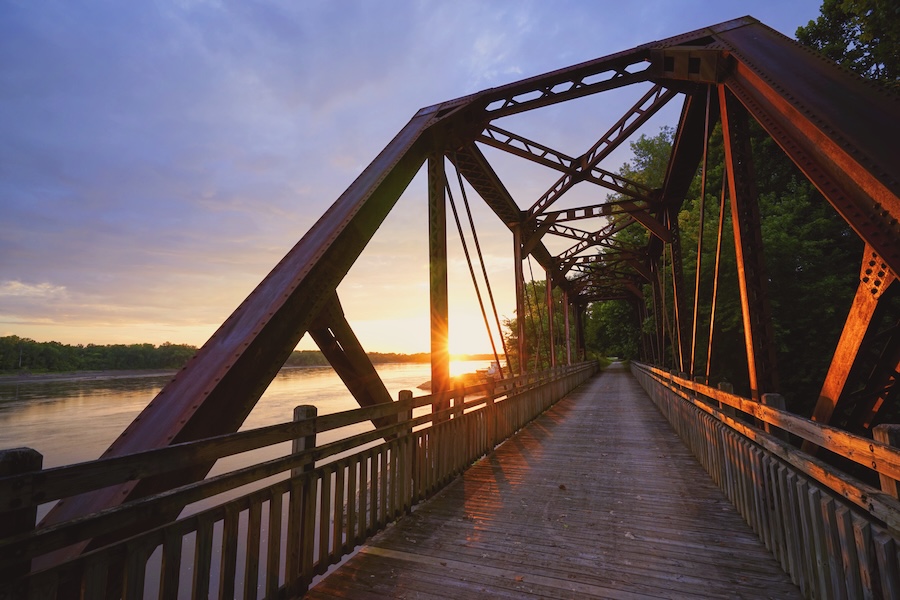
Rails to Trails Conservancy has been a champion of the railbanking law from the organization’s inception in 1986. Said Montange, “We were in an era of a lot of rail abandonment and RTC was pretty much formed to facilitate the implementation of Section 8(d) of the Trails Act.” After 40 years of backing thousands of miles of rail-trail conversions, he said, “I think it’s been a reasonably successful effort.”
Ferster, who assumed general counsel duties from Montange in 1992, echoed that sentiment, saying, “RTC has played a pivotal role in the defense of trails and railbanking. Many of the trails that are beloved to this day would not exist, but for our legal advocacy.”

“Many of the trails that are beloved to this day would not exist, but for our legal advocacy.”


Donate
Everyone deserves access to safe ways to walk, bike, and be active outdoors.
Related
View All
Profile: Accessibility and Safe Streets Advocate Juliette Rizzo
A View From … 2026 Hall of Fame Inductee: Virginia’s Mount Vernon Trail