Trail-Oriented Development
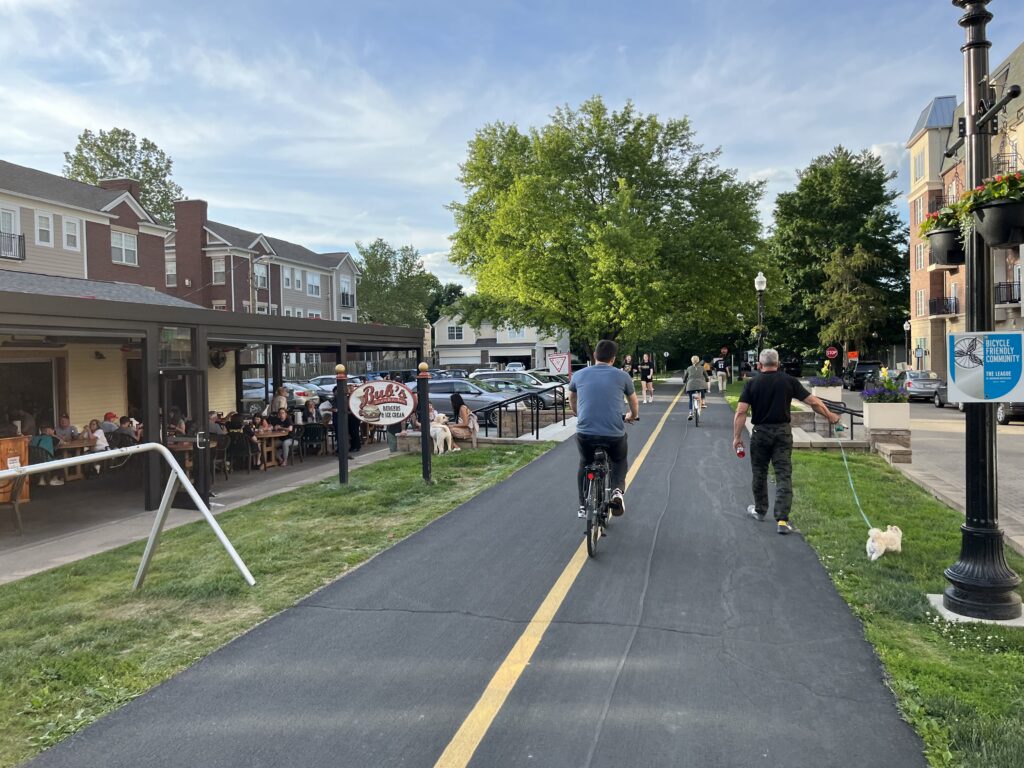
Monon Trail, IN| Photo by Kevin Belle
Trail-Oriented Development (TrOD) is an innovative planning approach that integrates multiuse trails with residential and commercial development to create walkable, bike-friendly communities. In these places, the trail is viewed as an asset that draws people in—whether visitors, customers or residents—enhancing mobility, strengthening local economies and promoting healthy lifestyles.
Similar to Transit-Oriented Development, TrOD clusters businesses, housing and other amenities around trails to foster vibrant and connected neighborhoods.
Benefits
For Businesses
Trail-oriented development can be an effective strategy for boosting retail sales. A Portland, Oregon study showed that customers who biked to a local shop made more frequent trips and spent more overall, despite spending less than drivers per trip.In addition, trails and active transportation amenities can be a draw for new corporate businesses looking to relocate and attract young, skilled workers.
For the Trail
Having amenities, businesses, cultural venues and other places for people to congregate along the trail makes it a destination in addition to a corridor for recreation and transportation. That builds a sense of place and stewardship. TrOD further opens the door for partnerships across sectors to build, maintain and/or activate segments of the trail. Potential partners include:
- Business improvement districts
- Chambers of commerce
- Real estate developers
- Real estate agents
- Community land trusts
- Community development organizations
- Business associations
- Neighborhood associations/ HOAs
- Community members
- Local and regional government (towns, cities, metropolitan planning organizations [MPOs], councils of governments [COGs])
- Transit agencies
- Artists (public art)
Along the Metropolitan Branch Trail in Washington, D.C., the NoMa Business Improvement District (BID) brings creative energy to the corridor with events and stewardship. For example, the Metropolitan Beer Trail is an event where participants receive a passport to be stamped at participating trailside bars and breweries. The businesses get foot traffic and sales while the trail serves as a lively connector. The BID also runs an annual mural festival that celebrates local artists and softens the hard edge between the neighborhood and the adjacent heavy-rail infrastructure. Alongside the trail, Alethia Tanner Park hosts a farmers market, outdoor movies and festivals that draw people in and build community.
Beyond events, NoMa BID also contributes to trail’s upkeep, handling tasks like graffiti removal and litter collection for which they are reimbursed by the trail’s owner, the District Department of Transportation.
For the Municipality and Region
Trails and trail-oriented development can generate new revenue streams through increased sales tax collections, higher property values, and value capture mechanisms that reinvest funds back into the trail network.They attract visitors, support local economic development and enhance quality of life, making communities more desirable places to live, work and visit.In some places, the trail is the selling point—proximity to the trail adds value.
For Communities
Trail access promotes healthy lifestyles and strengthens social connections by creating walkable, bikeable places where daily interactions can happen. The more destinations one can reach by trail, the more likely they are to choose an active mode to get there. This is also particularly beneficial for residents who cannot drive due to disability or other reasons.
Policy and Planning
Sometimes, trails are built first and then developers follow—drawn by the location and popularity. But municipalities and regions don’t have to wait for that to happen organically; they can take a proactive approach to planning for TrOD. That means being strategic in capitalizing on the trail’s appeal, in proactively engaging with potential public and private partnerships, and in implementing policies that reduce displacement and protect affordability as interest and investment grow. This is the intersection of transportation and land use.
The Central Indiana Trail-Oriented Development Study by the Indianapolis Metropolitan Planning Organization (IMPO) documents best practices for successful TrOD and identifies promising sites for activity nodes along their regional trails. The study includes design guidelines and strategies for overcoming challenges as well tool kits covering operations and management programming and financing.
Existing and future trails should be identified and included in planning documents (e.g., comprehensive plan, active transportation plan, trails master plan, etc.) Municipalities can use this to flag where developers will be required to dedicate land for trail development consistent with design guidelines established by the local government. Zoning codes may need updating to allow for higher densities, a mix of uses and reduced vehicle parking, and to require that buildings within priority corridors be physically oriented toward the trail. Taking a regional view also allows for planning connections to transit.
And while the trails can attract new investment to communities, it is crucial that the focus not be solely on the infrastructure itself, but on who benefits. Planners should prioritize equity and anti-displacement measures by engaging communities early and often to ensure inclusive planning and celebrate local heritage. They can anticipate where rising property values might lead to displacement and tailor their planning approach to ensure that new investment delivers the benefits aligned with community priorities. Municipalities can then implement proactive tools like property tax freezes, affordable housing incentives, and support for small and minority-owned businesses.
Finally, it’s important that the trail manager maintains the full trail—even outside of those activity nodes—ensuring a safe and pleasant experience for all.
TrOD Guidelines
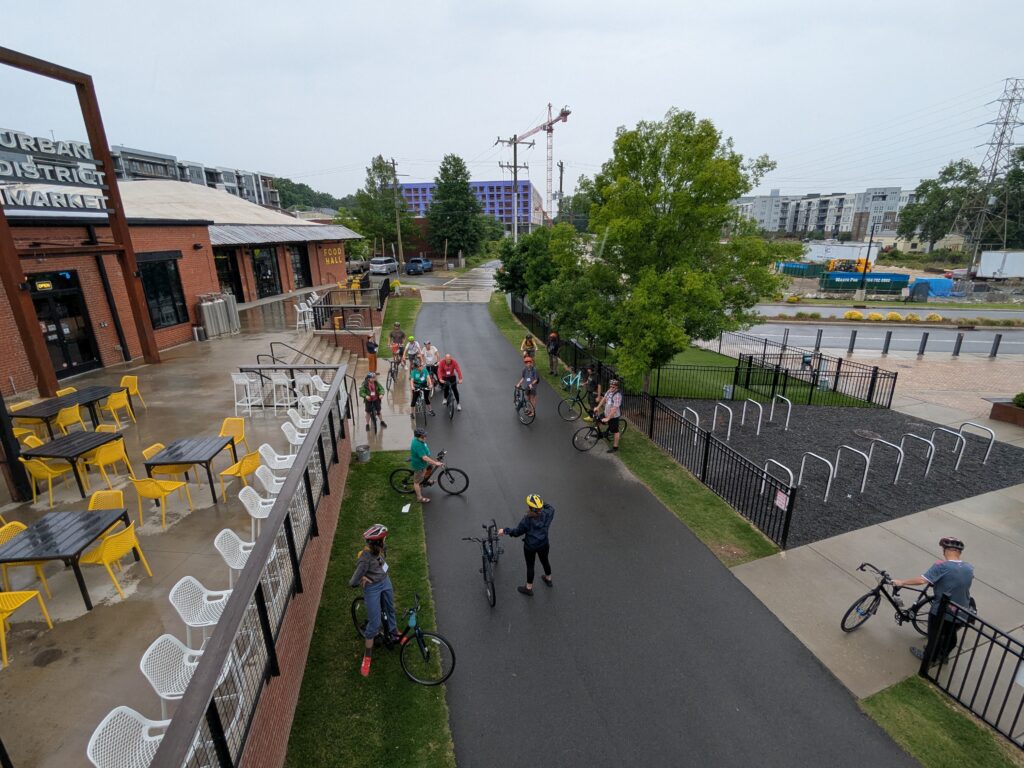
In the Central Indiana Trail-Oriented Development study published by IMPO, the authors explore different place typologies and design guidelines, applying them to trails within their footprint. That document is an excellent resource and goes into much more detail; but in general, here are some guidelines for TrOD:
Mixed-uses and density – Different kinds of developments at activity nodes make for a much more vibrant experience. These may include some combination single/multifamily housing, commercial, civic, community and green space, densely clustered around and near the trail.
Trail Access – Trail access should be well-marked and accessible from trailside buildings, nearby streets and trailheads. Street crossings should be safe and well-marked.
Signage and wayfinding – Signage can help with navigation as well as creating a recognizable and cohesive brand for trail users.
Active ground floors – This is crucial for any vibrant place and can be achieved through trail-facing entrances, transparency (windows), outdoor dining and gathering spaces, play areas, minimal setbacks and parking that located away from trail access.
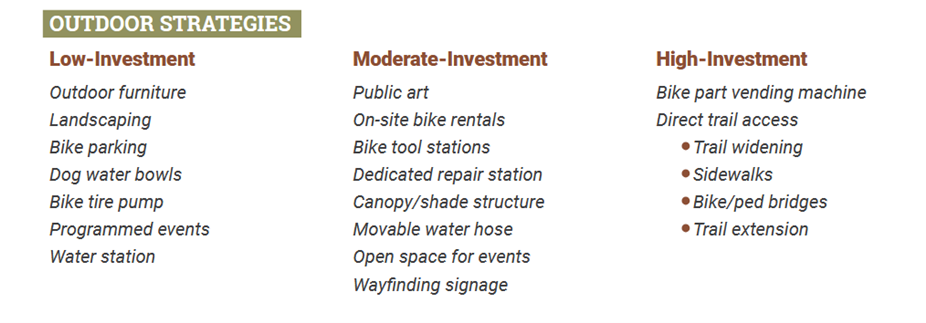
Amenities – Trailside amenities enhance the experience of being on a trail, making people feel safe and welcome and inviting them to linger a little longer. Examples of amenities are:
- Restrooms – May be provided by local businesses or civic/ community spaces such as libraries.
- Shade – Trees, umbrellas, trellises
- Seating – Passive seating areas or private dining areas
- Bike parking/bikeshare/bike storage – Making it convenient to arrive by bike
- Lighting – Creates a sense of safety and allows the trail to be usable for longer; may come from adjacent buildings.
- Landscaping and art – Not only are they aesthetically pleasing, but they help create a sense of identity for the trail. Green infrastructure can be used for stormwater management.
- Wayfinding and signage – Help orient trail users to different destinations; interpretive signage provides context and historical information.
TrOD in Action
Monon Boulevard/Midtown Plaza (Carmel, Indiana)
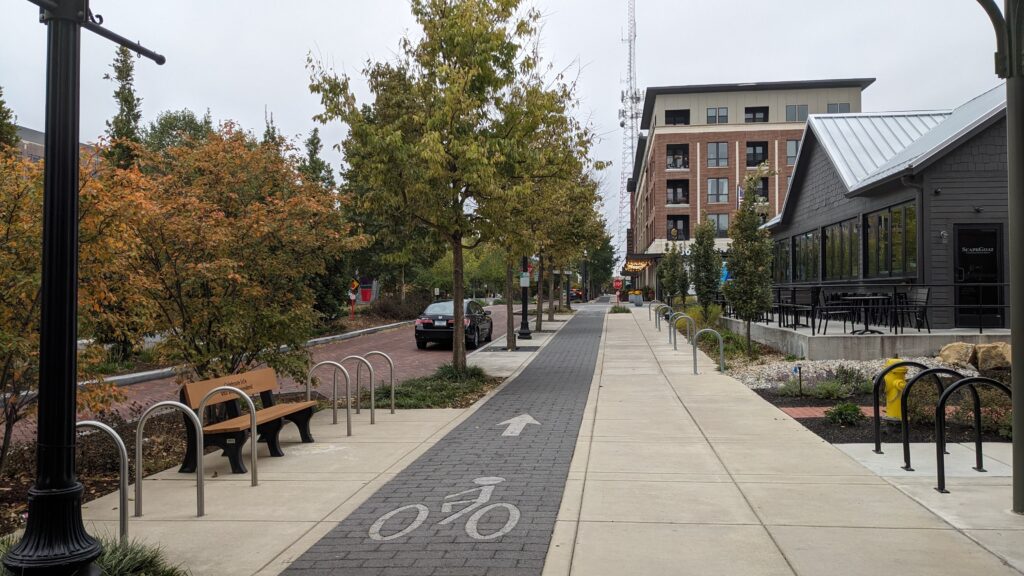
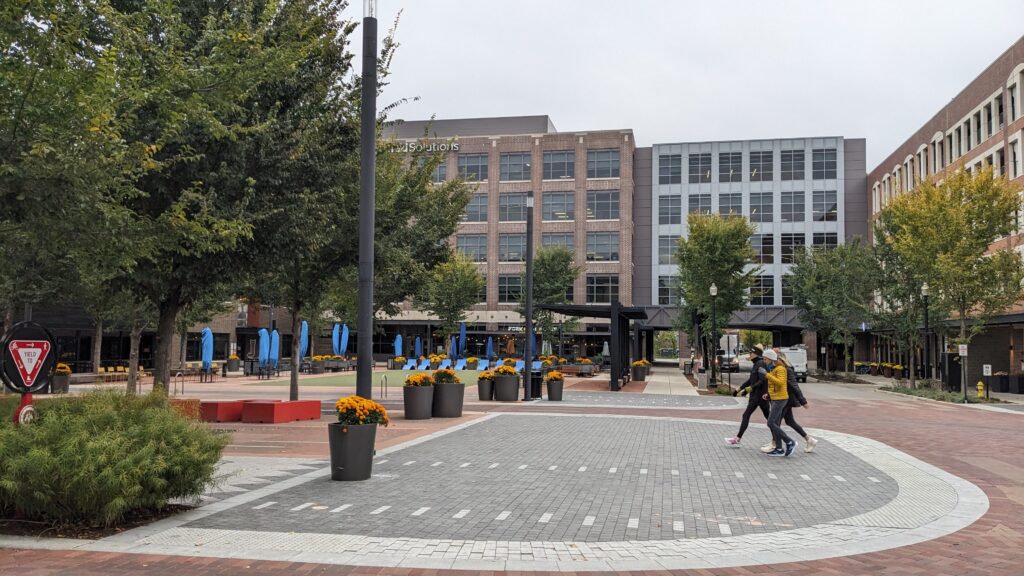
The 29-mile Monon Trail stretches across central Indiana, from Indianapolis north to Sheridan. The trail occupies the right-of-way of the Monon Railroad, which was abandoned in the 1980s. Plans to convert it to a rail-trail started in the 1990s, with the first 10 miles in Indianapolis opening in 1999, and 5.2 miles opening in the northern suburb of Carmel in 2001. Initially, the Monon Trail through midtown Carmel was little more than a 12-foot-wide asphalt path running through an industrial part of the city. The new Arts District and City Center were to the north and south of midtown, respectively. However, the 2012 Midtown Master Plan envisioned expanding the rail-trail into a complete street, with the goal of creating “an array of programmable and inclusive destinations for all seasons to engage a diverse mix of ages and abilities.” Thus began the redevelopment of the Midtown district, with the greenway as its spine.
Championed by Mayor Jim Brainard—and with the City of Carmel, Carmel Redevelopment Commission and Carmel Midtown Building Corporation—there was a $32 million investment in redeveloping the district, creating Monon Boulevard, a 140-foot multimodal complete street, in 2019. Throughout construction, the Monon Trail remained open as the new boulevard took shape around it. Landscaping, interactive art, and multicolored clay, granite and asphalt pavers helped designate pedestrian, bicycle and vehicular space.
Midtown Plaza is the midpoint of the boulevard, a versatile civic space that acts as a backyard for residents and a respite for office workers. The versatile park accommodates year-round active and passive recreation for all ages, with a large lawn, diverse seating options, shade structures, a splash pad, firepit, ping pong tables, corn hole, bocce ball courts and more. It is also a popular spot for community gatherings and performances, hosting outdoor movies, concerts and festivals. There are lots of destinations reachable by trail—places to eat, drink, shop and play. The redevelopment also incorporates green infrastructure, including permeable roadway, a 380,000-gallon subsurface water tank and a splash pad that also recirculates potable water.
The city’s investment in the Monon Boulevard/Midtown Plaza has in turn catalyzed an estimated $850 million in private investments around the district (as of 2022).This includes both multifamily residential and commercial investments. It also resulted in increased trail use by pedestrians, joggers and cyclists; increased numbers of visitors and attendance at community events; and higher property values for residences within a quarter mile of the trail. Carmel’s award-winning Midtown district redevelopment demonstrates what happens when the trail is seen as an asset, and how trail-oriented development can offer a return on investment both economically and in improving quality of life.
FIRST AVE Trail (Council Bluffs, Iowa)
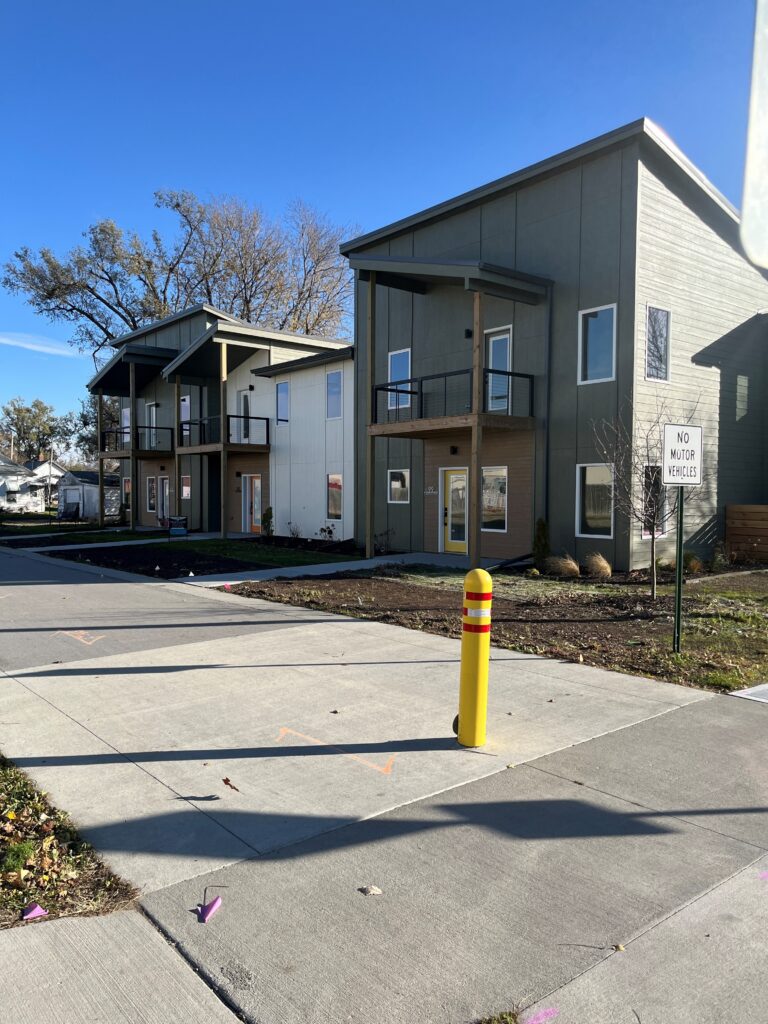
The FIRST AVE Trail is a 3.2-mile rail-trail in Council Bluffs, Iowa, part of the Omaha metropolitan region. The trail sits on a former railroad right-of-way that was platted as a street, First Avenue, but never used as one. When the line was abandoned in 2013, it reverted to city ownership. First Avenue is located one block south of West Broadway, the city’s main street. About 60% of Council Bluffs residents live within one mile of the corridor, and the population is projected to grow to over 1 million within the next 30 years.
First Avenue was always seen as more than a trail. The West Broadway Corridor Plan (2015) aims to “transform the former rail-line into a multimodal corridor featuring trails, transit and redevelopment.” This investment will hopefully then in turn attract real estate development in the blighted corridor, attracting residents and talent and strengthening the tax base. The City of Council Bluffs and the Iowa West Foundation committed $7 million to the redevelopment project. Three townhouses have already been built right off the trail—their front doors opening onto the trail and automobile parking in the back. Another 8.5-acre development featuring townhomes, multifamily housing and retail is underway at 34th Street.
Whereas industry ceased to use the trail, this is an opportunity to have the trail be the front door of new housing and commercial development while acting as a safe path to school for students and staff of Thomas Jefferson High School and Edison Elementary. In fact, the trail bisects the high school’s two buildings, just like the old train line—though the trail now acts as a unifying feature instead of an obstacle.
The paved trail features attractive landscaping and a menu of amenities, including green spaces, shaded seating, bicycle parking and bikeshare, LED lighting for 24-hour trail use, and a public-library automated lending kiosk. Trail plazas are located every few blocks and pay homage to the area’s railroad and industrial past through their design. As the trail passes Thomas Jefferson High School, it features additional landscaping, black welded-wire fencing with gates, ADA-compliant ramps leading to the school, and long seating walls for both students and anyone using the trail.
The FIRST AVE Trail is also viewed as part of a regional transportation system. It connects to other trails and walking and biking facilities, including the Iowa Riverfront Trail and Bob Kerrey Pedestrian Bridge into Omaha. It’s also part of the Great American Rail-Trail®, the nation’s first cross-country multiuse trail, which will stretch more than 3,700 miles between Washington, D.C., and Washington State. The trail is offset south within the 66-foot right of way to leave room for a potential transit line. A study is underway to propose additional transportation linkages between downtown Council Bluffs and downtown Omaha across the Missouri River. A streetcar line is one option, especially since Omaha announced it was investing in streetcars and has already surpassed projections for investment within the tax-increment financing district (money from the TIF pays for the streetcar development and also is directed to affordable housing).
FIRST AVE is more than a trail—it’s an aspiration evident in its name: Furthering Interconnections, Revitalization, Streetscapes, Transportation and Aesthetics for a Vibrant Economy.
Resources
‣ Webinar – Trail-Oriented Development: How Trails Create Connected Communities
‣ Manual – Central Indiana Trail-Oriented Development Study
‣ Manual – The Right Path: A Trail-Oriented Development Primer
‣ Article – Emerald Trail System Case Study
TrailNation Collaborative
TrailNation™ Collaborative is a nationwide peer learning community from Rails to Trails Conservancy that brings together advocates, leaders and professionals from across disciplines to establish and accelerate trail networks across America. The collaborative provides proven tools, methods and resources, combined with RTC’s expertise and network of partners across the country, to accelerate the development of connected trail systems. When trails are connected across regions and states, trail networks have a proven transformative impact—they are essential infrastructure that creates thriving, healthier communities.