North Carolina’s Ecusta Trail: May 2026 Trail of the Month
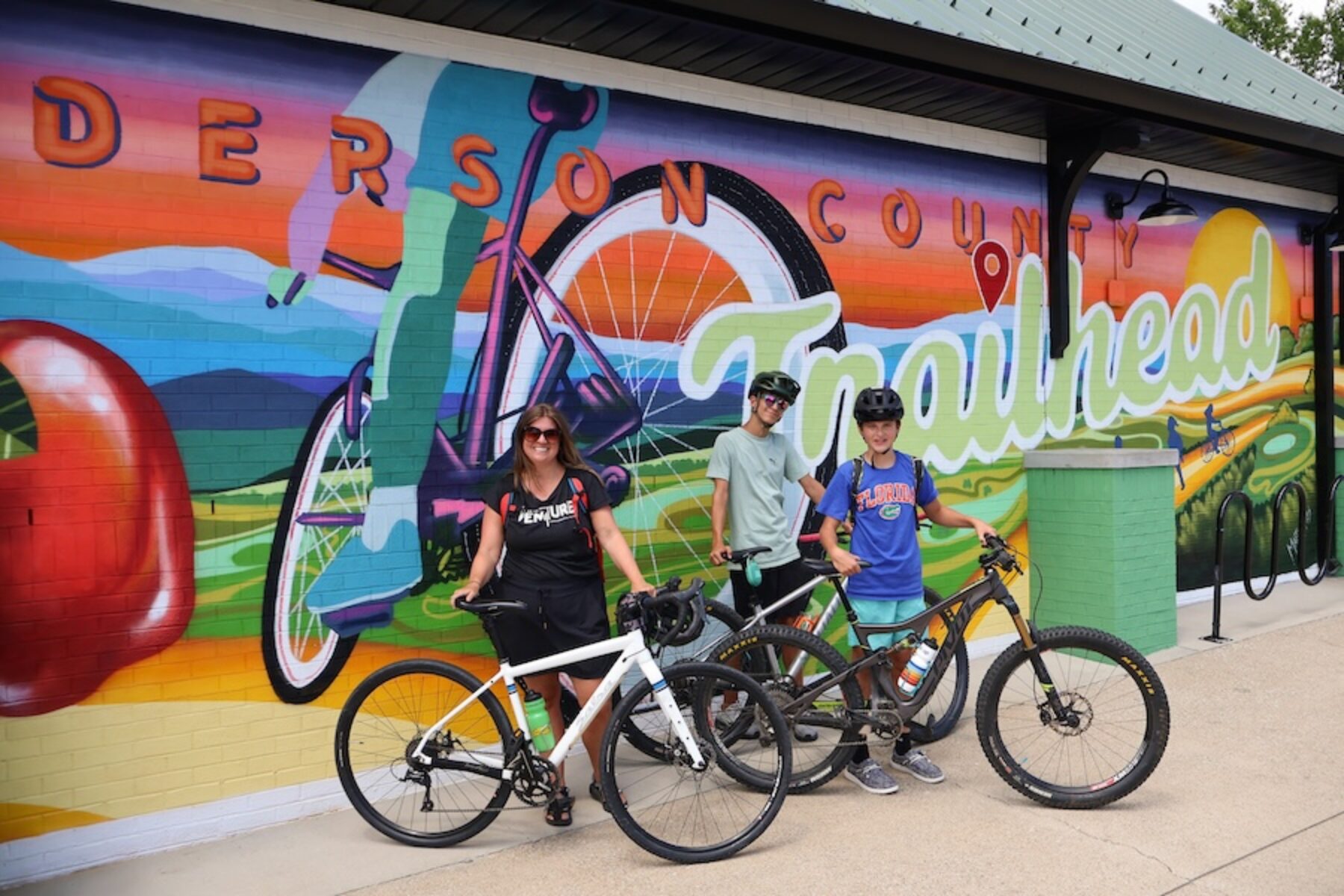
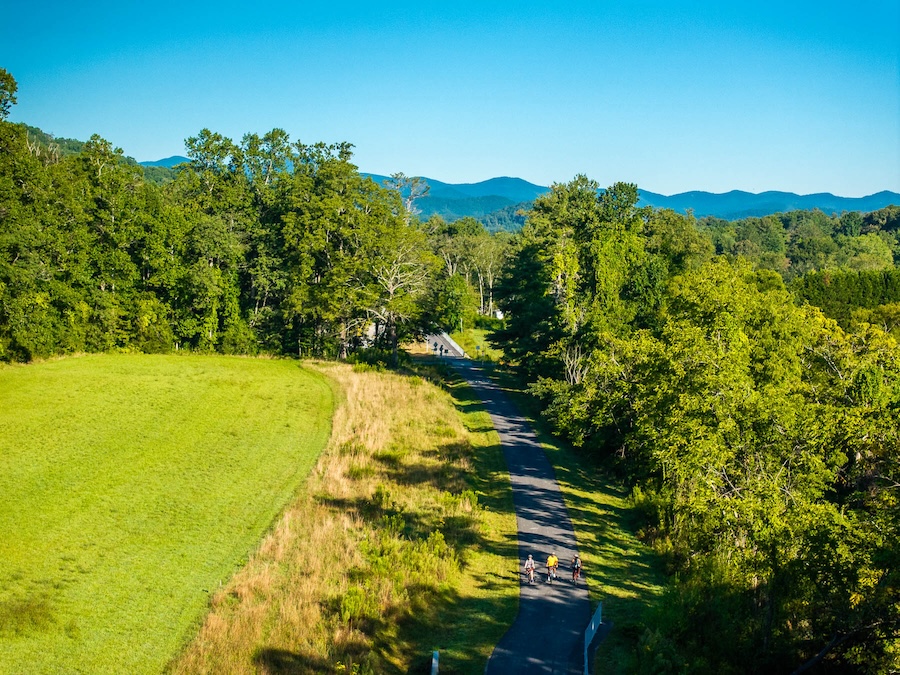
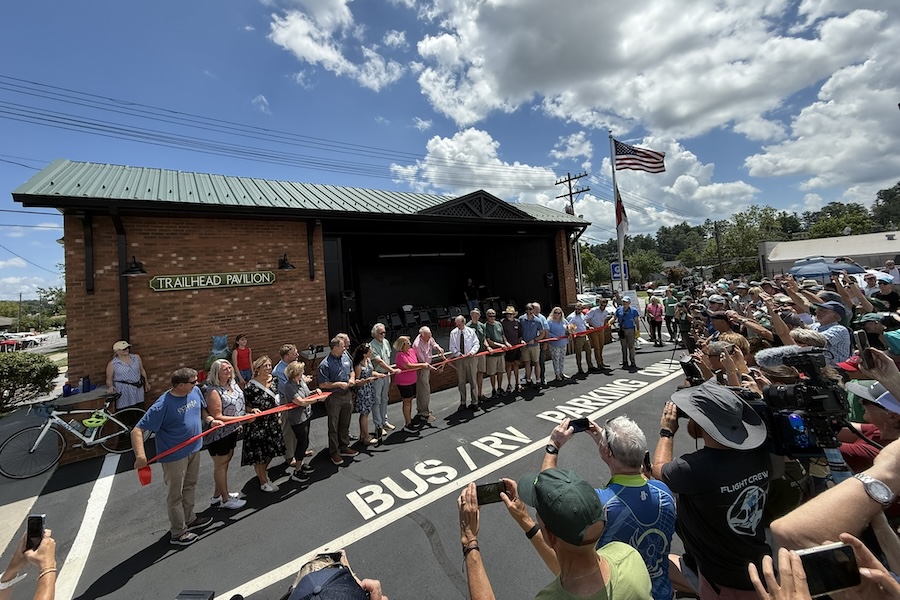
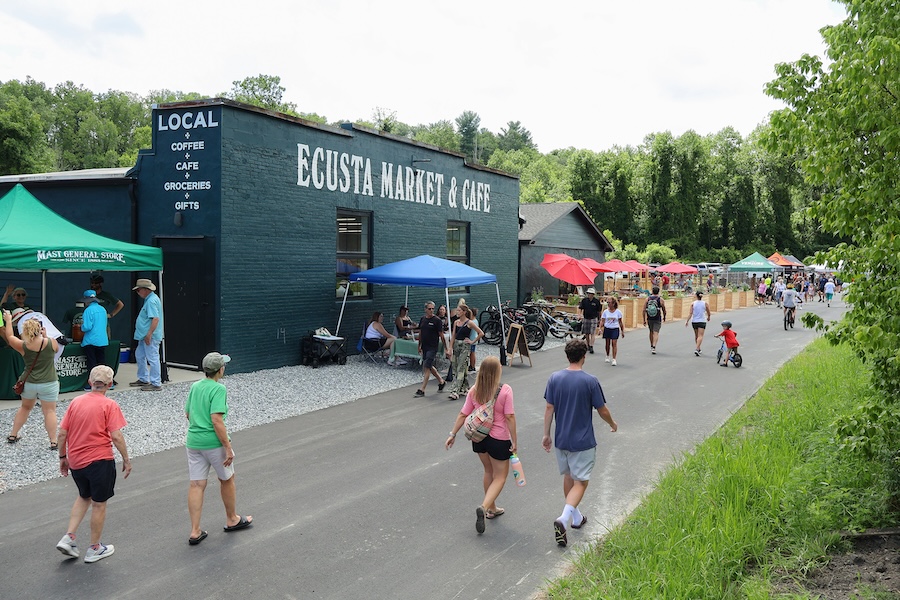
It’s an unseasonably hot April morning, and retirees Kevin Donnelly and Amy Sullivan are having lunch at one of the umbrella-shaded picnic tables outside the stylish Ecusta Market & Cafe in Hendersonville, North Carolina. Just a few feet away, their e-bikes are parked along the state’s newest rail-trail, the Ecusta Trail, which opened in July 2025 and runs 6 miles westward from downtown Hendersonville to Horse Shoe.
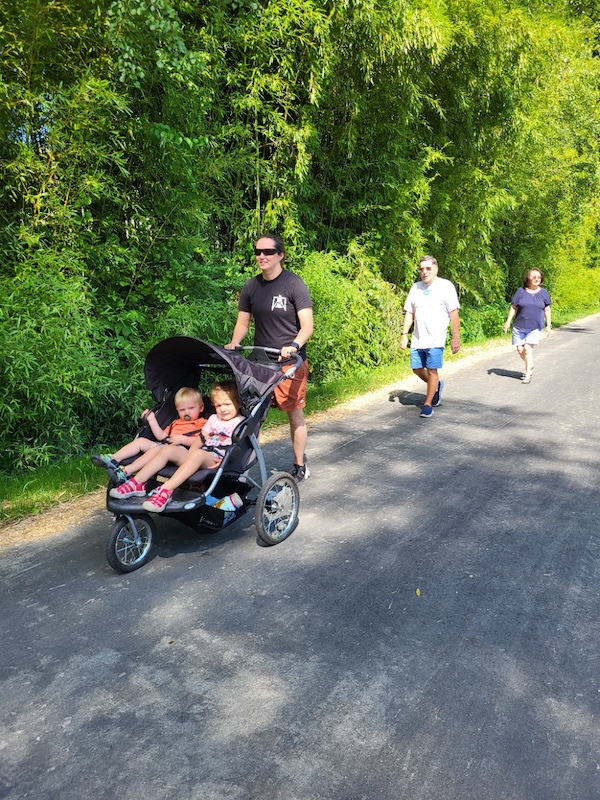
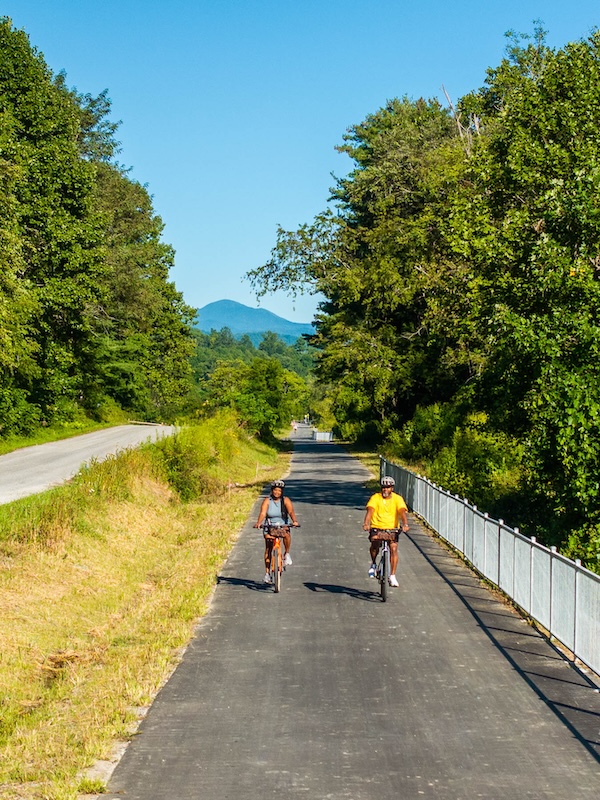
Donnelly and Sullivan, residents of the nearby town of Flat Rock, visit the Ecusta Trail about three times a week. During each trip, the couple patronizes one of the many local businesses alongside it, some of which, like the Ecusta Market & Cafe, set up shop in anticipation of the trail’s opening. They said they’ve been impressed by how scenic the route is. On the relatively short path from Hendersonville to Horse Shoe, the trail traverses an impressive variety of urban, suburban and rural landscapes. In between fully wooded stretches offering stunning views of Western North Carolina’s mountains, it passes by several restaurants and coffeeshops, a public housing development, a brewery, a synagogue, a gem mine, a self-pick berry farm and numerous subdivisions.
But the Ecusta Trail’s transformation into a new community hub didn’t happen overnight. “Like everybody else, we were waiting for it to get completed,” said Donnelly.
A Community Effort
The trail’s story begins in 2002, with the closure of the RFS Ecusta paper mill in Pisgah National Forest, just north of Brevard. The former flax pulping and paper manufacturer began operations in 1939 as the Ecusta Paper Corp., and was connected by rail to Hendersonville via a 20-mile line built by the Hendersonville and Brevard Railway, Telegraph and Telephone Company. Founded by German-Jewish immigrant Harry Hans Straus, the company boasted the United States’ first plant dedicated exclusively to making cigarette-rolling paper. Straus and his engineers invented a unique roller system inspired by textile manufacturing that could process flax into the highly delicate paper product. The operation required clean water, which the nearby Davidson River supplied.
The mill became an economic and social anchor of the area. In a 2024 Transylvania Times article about it, county library historian Laura Sperry writes that the factory “had a cafeteria with food for sale at-cost and seating for everyone regardless of purchase, a library run by the local head librarian and an employee-accessible recreational lake.” Additionally, there was a monthly employee magazine, The Echo, that “highlighted the many social connections and activities provided for Ecusta employees.”
In 2001, after changing ownership several times, the mill fell into the hands of the UK-based Purico Limited. The company shut it down the following year after a tumultuous labor dispute, laying off some 650 workers. As in many small towns, the closure had major repercussions. A reflection in the Hendersonville Times-News around the time of the shutdown noted that “from the time the plant’s initial four paper machines started rolling, Ecusta provided a stream of good wages that helped mountain families pull themselves out of the poverty of the Depression.”
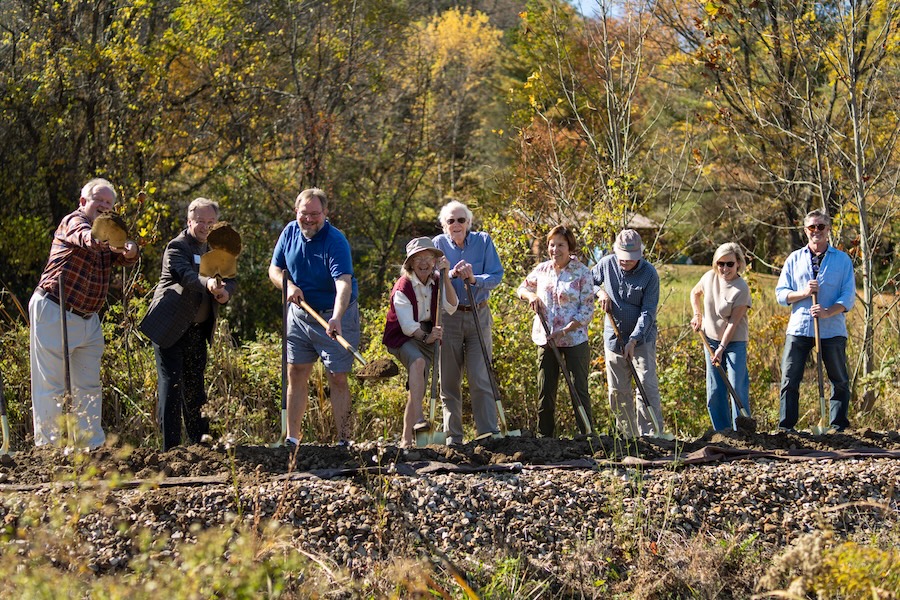
Area residents interested in converting the rail spur into a trail began meeting informally in 2007 to discuss its future. A year later, the City of Hendersonville passed a resolution supporting the creation of a rail-trail, and the following year, the Friends of Ecusta Trail (FOET) was officially incorporated as a nonprofit. With these first crucial pieces in place, the group got to work: raising money, advocating for the trail to policymakers and convincing their neighbors of the benefits it could bring to the area.
Their efforts were “very, very grassroots,” said FOET’s executive director, Laura Rice. “They would meet with local elected officials and share what a rail-trail was, share what railbanking was.” As part of their education campaign, they invited officials to visit successful rail-trails in the region, such as the Virginia Creeper in southwest Virginia and South Carolina’s Prisma Health Swamp Rabbit Trail, which runs from Travelers Rest to downtown Greenville and beyond.
It didn’t hurt that board members included Chuck McGrady, a future member of the North Carolina House of Representatives, and Chuck Edwards, a future North Carolina state senator and the current congressman for the state’s 11th district. After his election to the state senate in 2016, Edwards helped secure $7.5 million in state funds for the trail.
As part of its planning and fundraising, FOET worked with Rails to Trails Conservancy and, locally, with Conserving Carolina, a land trust operating in Western North Carolina and the South Carolina Upstate. With Conserving Carolina serving as the project’s fiscal agent, funding steadily accumulated from various state and federal agencies, a portion of Henderson County’s lodging tax revenue and private donors. (Though today, FOET manages its own finances and accepts all trail-related contributions.)
From Rail to Trail
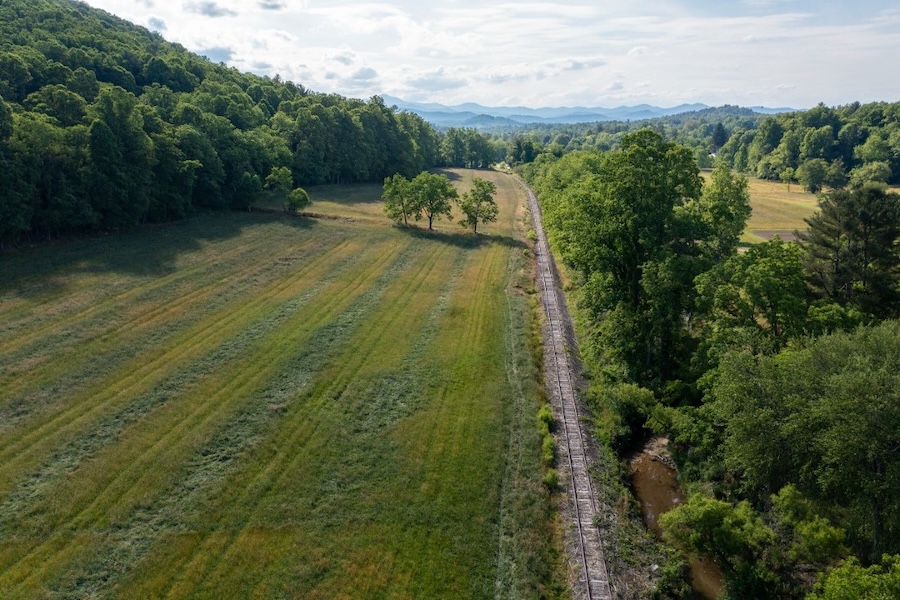
Conserving Carolina also took a leading role in negotiating with the railbed’s most recent owner, Blue Ridge Southern Railroad. While the land trust had already purchased and preserved tens of thousands of acres, they had never bought a former railbed, and “there was a learning curve associated with that, as well as with the railbanking process with the federal Surface Transportation Board,” said Rebekah Robinson, assistant director for programs, who helped lead the purchase. “We had to educate ourselves on how real estate and property law applies differently to railroads.”
Interestingly, that newfound knowledge was readily applied a few years later to the Saluda Grade Trail project, a 31.5-mile future greenway whose land Conserving Carolina co-purchased in June 2025.
The process wasn’t without its challenges. Some landowners along the rail line filed lawsuits, believing the sections bordering their property would revert to them when the railway ceased operations; in June 2024, 164 owners were awarded a combined $5 million in damages from the federal government. In Transylvania County, “there was a lot of opposition,” said Rice, because residents hoped to attract new manufacturing businesses and worried that deactivating the rail line could prevent that from happening.
But eventually most residents seemed to get on board, said Henderson County Manager John Mitchell, thanks in part to the efforts of FOET. In November 2020, perhaps the clearest verdict on the group’s years of work arrived: a vote by the County’s Board of Commissioners on whether to approve a $7 million bridge loan to Conserving Carolina, which it needed to purchase the railbed. The commissioners voted unanimously in favor.
Less than a year later, Conserving Carolina purchased the railbed from Blue Ridge Southern for $7.8 million. Construction of the first 6 miles, which are now enjoyed today, began in December 2023.
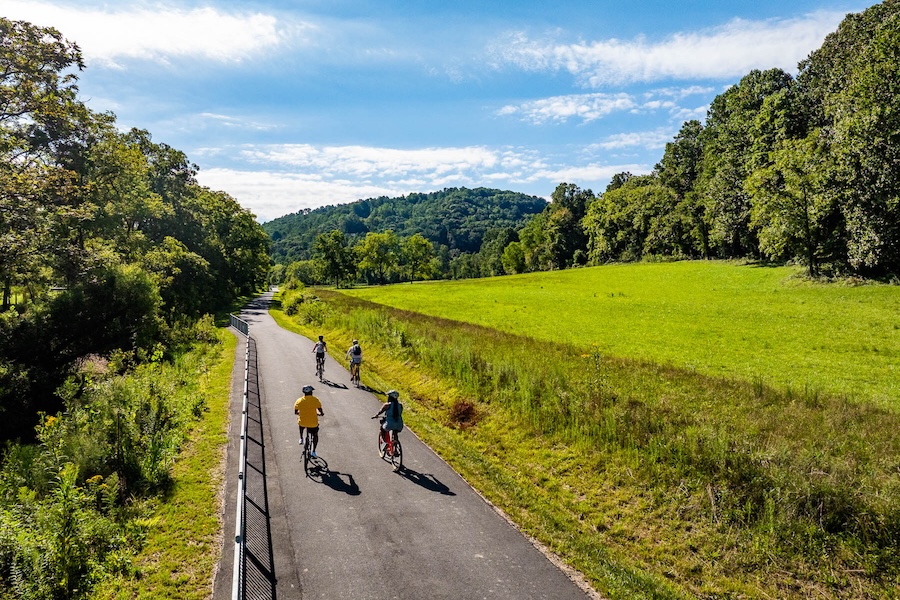
The trail’s second phase of construction, set to begin next year and finish in 2029, will extend the route another 13.5 miles southwest to downtown Brevard, the seat of neighboring Transylvania County. The extension will bring the total length of the trail to 19.5 miles and provide access to this gateway community for exploring the expansive Pisgah National Forest, a popular area for hiking, camping and other recreational opportunities.
A Boost for Business
Rice, who started her role in September, is FOET’s first executive director; before she began, the board was entirely made up of volunteers. She said just as the trail itself has transformed, so has the organization. Today, its role is more focused on “supporting the trail now that it’s on the ground, instead of arguing that it should be here.”
Part of this support involves ensuring that trail usage and investment around it continue to grow. In early May, FOET stationed trail counters to measure usage, and the findings will be released later this month. Anecdotally, much of the feedback has already been encouraging.
“It’s been a blessing,” said Lori Rodriguez, a co-owner of Southern Streams CoffeeHouse, which abuts the trail in the town of Laurel Park, just west of Hendersonville. “I see so many people out. I mean, it was a very outdoorsy community anyway, but I think this has just tripled it, if not more.”
Southern Streams is a government-sanctioned trail partner. In exchange for being listed on the official Ecusta Trail map, Rodriguez has agreed to provide water to trail users and let them use Southern Streams’ restroom. There have been some growing pains but they’ve been minimal, she said. Car parking is a challenge, but she was able to work with a nearby church to provide overflow spots. And she recently installed a bike rack to account for all of the new non-motorized traffic.
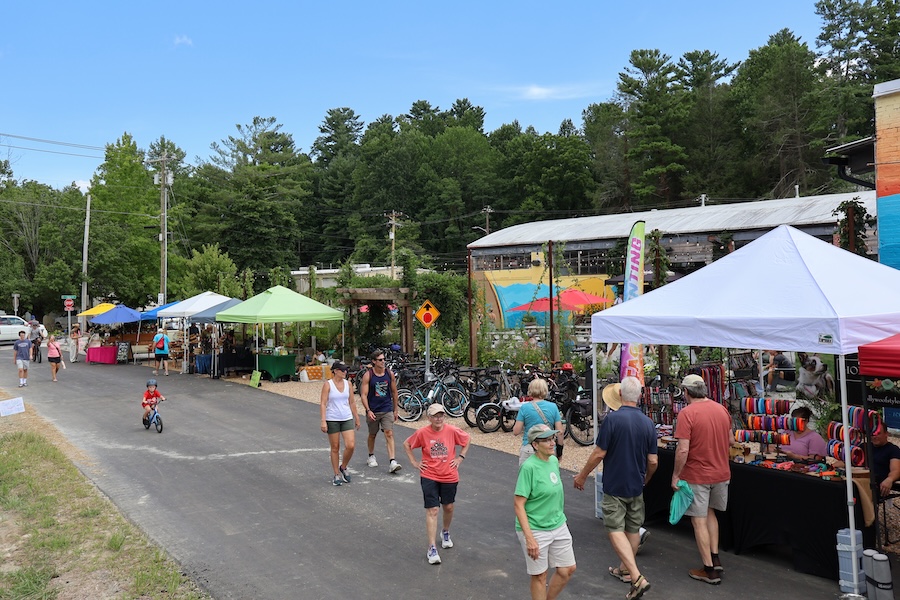
A little farther down the trail, around Mile Marker 3, the Elijah Mountain Gem Mine has also seen a boost in customers arriving by bike. Longtime manager Heather Allison said it’s also motivated the business, located just off the trail, to set up a dedicated bike station. “It’s been beneficial … which is what we’ve been hoping for.”
Hendersonville resident Michael Elliston lives within walking distance of the trail, using it three or four times a day, either accompanied by his dog, Ginger, or by his family. “It’s pretty awesome to just head straight on through to wherever you want to go from the trail,” he said. “Me and my wife will bring the kids out in the early evening. Grab some food, grab a beer.”
These kinds of positive responses hardly come as a surprise to Mitchell, the Henderson County manager. “I think it’s already become one of the most treasured recreation resources in the county and the region,” he said. He’s been working for the county for around 10 years, so he’s seen—if not participated in—many of the twists and turns any project of this size inevitably takes.
“The railroad had such significance, especially in Transylvania County, that we can kind of keep that alive and have it still be an economic driver,” said Rice. “It’s just on foot or bicycle versus train.”
Related Links
Trail Facts
Name: Ecusta Trail
Used railroad corridor: Blue Ridge Southern Railroad
Trail website: ecustatrail.org
Length: 6 miles currently; 19.5 miles when the next phase is complete (estimated for 2029)
County: Currently, the trail is only located inHenderson County but, when complete, it will extend into Transylvania County.
Start point/end point: S. Main Street and S. King Street (Hendersonville) to Brevard Road and Battle Creek Road (Horse Shoe)
Surface type: Asphalt
Grade: The trail’s grade is mostly between 1% and 2%. There are only two sections with moderate hills; one is located between the downtown Hendersonville terminus and Church Street, and the other lies between Daniel Drive and White Pine Drive in Laurel Park (just west of Hendersonville).
Uses: Walking, biking and inline skating; wheelchair accessible
Difficulty: With a paved, level grade, this trail is considered easy.
Getting there: The nearest commercial airport to the trail is the Asheville Regional Airport (61 Terminal Drive, Fletcher), located 13 miles from the trail’s terminus in Hendersonville.
Access and parking: Parking is available in Hendersonville at the Hendersonville Welcome Center Trailhead (201 S. Main St.) and at Lennox Station (441 S. Whitted St., Hendersonville).
To navigate the area with an interactive GIS map, and to see more photos, user reviews and ratings, plus loads of other trip-planning information, visit TrailLink, Rails to Trails Conservancy’s comprehensive trail guide, offering more than 40,000 miles of multiuse trails.
Rentals: For bike rentals, visit Venture Ecusta (875 Lenox Park Drive, Hendersonville; 828.450.6635), located adjacent to the trail.

Donate
Everyone deserves access to safe ways to walk, bike, and be active outdoors.
Related
View All
Children’s Book Inspired by Real Events Shines Light on Community Trail Stewardship
Profile: Accessibility and Safe Streets Advocate Juliette Rizzo