Reconnecting Communities Grants Prioritize Walking and Biking as Essential in Addressing Barriers to Equitable Mobility and Economic Opportunity
FOR IMMEDIATE RELEASE:
March 2, 2023
CONTACT:
Patricia Brooks, Patricia@matchmapmedia.com, 202.351.1757
Reconnecting Communities Grants Prioritize Walking and Biking as Essential in Addressing Barriers to Equitable Mobility and Economic Opportunity
Rails-to-Trails Conservancy’s analysis identifies trend elevating trails, walking and biking as traffic safety, climate and equity solutions in U.S. Department of Transportation grantmaking
WASHINGTON, D.C.—This week’s announcement of grantees under the U.S. Department of Transportation’s (USDOT) newest multimodal program, Reconnecting Communities, continues to underscore the importance of trails, walking and biking in addressing some of the biggest challenges facing communities nationwide—including racial disparities in access to mobility, greenspace and economic mobility, says Rails-to-Trails Conservancy, the nation’s largest trails and active transportation advocacy organization.
The Reconnecting Communities program is designed to “reconnect communities that are cut off from opportunity and burdened by past transportation infrastructure decisions.” While removing or redesigning transportation facilities that have divided neighborhoods is the focal point of project awards, many included bicycle and pedestrian infrastructure in construction and planning grants, reinforcing its importance in overcoming historic barriers to equitable mobility and access. Many grantees also reinforced the importance of improving walking and biking safety, and addressing climate emissions by encouraging active transportation—bringing solutions to broader social issues that disproportionately affect communities of color and low-income communities.
“Complementary trends are emerging that reinforce what we’re seeing across the country—communities are demanding investment in infrastructure that ensures more equitable access to opportunities and provides safer and more convenient routes to walk and bike. The U.S. Department of Transportation is prioritizing investments that deliver both,” said Kevin Mills, RTC’s vice president of policy. “Reconnecting Communities further validates bicycle and pedestrian infrastructure as fundamental to providing equitable mobility and access to economic opportunities—regardless of race, income or whether people drive. It’s also another example where demand for this investment far outpaced the supply. Nearly 90% of eligible projects weren’t funded. The nation needs more money and strategic focus to expeditiously build the active transportation networks necessary to ensure that all Americans have safe and affordable access to jobs and vital services.”
The program, which specifically includes eligibilities for trails and other walking and biking infrastructure, is one of several made possible under the Bipartisan Infrastructure Law creating new opportunities for communities to leverage federal funding to create and connect active transportation infrastructure. Most of the awards include safe and convenient accommodations for pedestrians and bicyclists as an essential part of the solution to historic barriers to mobility and access. Many also include the creation or enhancement of parks and greenspaces that may be otherwise lacking.
Several of the Reconnecting Communities grantees showcase the role of trails, walking and biking in addressing significant issues facing communities. Long Beach, California, received $30 million to redesign West Shoreline Drive to increase safe access to the ocean, downtown and key destinations, with funding to create a new bike path and pedestrian amenities as well as a 5.5-acre park. Buffalo, New York, received $55.6 million to cap a highway, create new greenspace and employ Complete Streets design principles to ensure pedestrian safety and access to community services and amenities. In Oakland, California, funding for a feasibility study regarding removal of Highway 980 in conjunction with Oakland’s Grand Avenue Mobility Plan will advance plans to improve walking and biking access to the future West Oakland Link and overall Bay Skyway—a priority for the Bay Area Trails Collaborative, one of RTC’s TrailNation™ projects.
“These awards are encouraging as they signal a deeper understanding that how we invest in walking and biking infrastructure makes a significant difference to the well-being of communities,” said Mills. “While these competitive multimodal grant programs have proven to be an important funding source for trail and active transportation networks, they aren’t enough if communities can’t plan around these resources for the long-term. This is why it’s essential that Congress fully fund the Active Transportation Infrastructure Investment Program and sustain and grow it over time to provide the dedicated funding necessary to bring safe, connected active transportation infrastructure to every neighborhood.”
The Active Transportation Infrastructure Investment Program (ATIIP) is a new program that provides dedicated funding for the planning and construction of safe and connected active-transportation networks and long-distance spine trails. The program was authorized in the Bipartisan Infrastructure Law and received its first appropriation in the Fiscal Year 2023 federal funding bill. RTC, Congressional champions and partners across the country are continuing to advocate for full program funding in the FY 2024 federal budget. Learn more about the demand for trails, walking and biking infrastructure and available federal funding at railstotrails.org/policy/funding.
Rails-to-Trails Conservancy is the nation’s largest trails organization—with a grassroots community more than 1 million strong—dedicated to building a nation connected by trails, reimagining public spaces to create safe ways for everyone to walk, bike and be active outdoors. Connect with RTC at railstotrails.org and @railstotrails on Facebook, Twitter and Instagram.
Donate
Everyone deserves access to safe ways to walk, bike, and be active outdoors.
Related
View All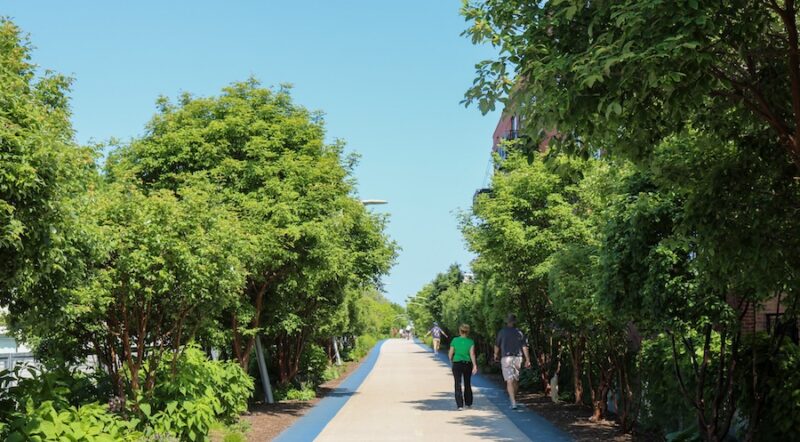
Illinois’ Bloomingdale Trail: October 2026 Trail of the Month
Rails to Trails Conservancy Grants Underscore an Urgent Truth: Demand for Safe Spaces to Walk and Bike Outpaces Available Funding Nationwide