West Virginia’s Meadow River Rail Trail March 2026 Trail of the Month

In the hushed woodlands of southern West Virginia, word is getting out about the Meadow River Rail Trail quietly unfurling along the leafy water’s edge. Situated between the state’s newest national park and its newest state park (New River Gorge National Park and Summersville Lake State Park, respectively), the trail provides a way to truly experience deep Appalachia.
“We are in the hub of outdoor activity,” said Peggy Blankenship Heater, who owns the Meadow River Campground tucked along the river just steps from the 11-mile pathway. “It doesn’t matter if you go north, south, east or west. Anywhere within a two-hour radius, you’re going to find something that’s amazing—and you’re not going to get bored. You need a week at least to really see things and, even then, you’d be lucky to see it all.”

Scenic and remote, the trail is a get-away-from-it-all kind of place with cell phone service available only at its three trailheads. Its compacted, crushed-limestone surface is good for biking, walking and—Blankenship Heater’s passion—horseback riding. And just like most everything else in this region, the Meadow River itself—the trail’s constant companion—offers variety, too: a mix of choppy, boulder-strewn rapids and gently flowing flatwater that, depending on where you are, is the go-to place for kayaking, whitewater rafting, fishing, swimming and tubing.
“Everything about it is beautiful, especially in the fall when you can stand on the trail bridge and watch the leaves go down the river,” said Blankenship Heater. Adding in a conspiratorial tone, like she’s keeping a well-kept secret, “I’ve lived here all my life and sometimes it’s kind of hard to want to share it with other people.”
Although half the trail’s ultimate length has yet to be realized, its potential to entice tourism and spur economic development is building excitement for its completion.
New Beginnings

Following the former route of the Fayette, Nicholas & Greenbrier Railroad built in 1907, the rail-trail offers fresh possibilities to this time-worn place where coal and lumber industries reigned for more than a century, and railroad mile markers still herald distances in faded numbers on weathered stone.
For Matt Ford, the trail’s manager appointed by the Fayette and Greenbrier County Commissions for nearly a decade, the project is personal: His family has lived in this region for seven generations, and he currently resides in Rainelle, one of the towns that will soon be connected by the trail. “When I went away to college and then started working in the Charleston area, I would come back home, and every time I’d come back to visit, it seemed like the town was worse and worse off.”
After moving back to Greenbrier County in 2007, he founded the nonprofit Meadow River Valley Association in 2018 to develop projects that would help revitalize the community.

“The rail-trail seemed like something that would be able to attract people and help replace some of the economy that was lost when the town lost their coal mines,” said Ford. “The town also once had the world’s largest hardwood lumber mill, but that closed in the 1970s, and I just thought the trail was a project that could help reverse the trajectory that the community was on after the closure of all the industries that were the reason the towns existed in the first place.”
The trail follows and occasionally crosses the Meadow River, a county boundary, so trailgoers will move between the rural counties of Greenbrier and Fayette. Rainelle, the largest community along the route, with a population of around 1,300, hosts western Greenbrier County’s only stoplight.
“We’re trying to figure out how to connect between Rainelle’s main street and the trailhead,” explained Ford. “We’re actually going to start a shuttle service in town, called Meadow River Guides & Gear, in a building right at the stoplight. And we’re planning to have an outdoor concierge and bike rentals available there as well.”

Bringing Positive Change

An important partner for the trail project is the New River Gorge Regional Development Authority (NRGRDA), which funded a new regional outdoor recreation plan along with Partner Community Capital—published just last month—that provides a 15-year roadmap for advancing outdoor recreation, economic development and community vitality across the Meadow River Valley. A major part of the plan is the continued development of the Meadow River Rail Trail, including expanding river access, improving trailhead facilities and enhancing the trail with public art.
“Anyone who’s spent much time in southern West Virginia will know that plenty of things have been heralded as the savior, the economic solution to long-term economic decline,” said Andy Davis, NRGRDA’s Manager of Gateway Initiatives. “But the big focus within West Virginia on outdoor recreation is not as the magic pill—not just the one thing that solves everything else—but as something that’s worth doing because it not only makes the community more attractive for investment from businesses, it makes it a better place to live for those of us who are already here.”

Melanie Seiler, who has spent most of her life in West Virginia, is looking forward to finding ways that the trail can be used to encourage more locals to be physically active. The nonprofit she runs, Active Southern West Virginia, promotes healthy lifestyles and programming led by trained community volunteers. “In the community of Rainelle, there will be more trail access, and I’m excited for that development so families from the neighborhood can get to it,” she said. “I’m always interested in ‘doorsteps to trailhead’ projects, where the community can easily get there, and it’s not just a destination trailhead that everyone has to drive to.”
As an outdoor enthusiast who grew up in Fayette County, Seiler knows the difference that reducing the barriers to exercise can make. “We have some of the poorest health outcomes in the nation, and a lot of those revolve around obesity and chronic diseases, like diabetes,” she said, noting published data showing West Virginia’s high obesity and inactivity rates (40% and 27%, respectively). “So we have to continue to put forth strong efforts in community health and wellness. We have these great outdoor assets, and economically, it’s very affordable for families to adopt active lifestyles and increase physical activity.”
Opportunity Knocks

Back in 2008, the potential impact of the rail-trail was so apparent that the commissioners for both Greenbrier and Fayette counties jumped on board with the idea when opportunity literally came calling. On the other end of the phone line was Peggy Pings.
Since 1995, Pings had been working as an outdoor recreation planner with the National Park Service in West Virginia on projects like the North Bend Rail Trail, when she learned that the rail corridor—owned by CSX at the time—was headed for abandonment. Understanding its value from her experience with other rail-trails, she rang the county commissioners and arranged a meeting with CSX and local elected leaders.
“We’re all in the room together, and the deal was made right then and there on the spot,” Pings recalled. “They came up with $66,000, or something like that, to buy the corridor. It was the easiest thing I’d ever seen happen.”
Construction began on the project in 2014 and, prior to Matt Ford, was spearheaded by the late Doug Hylton, a resident of nearby Ronceverte and an active community volunteer. A year later, the trail’s first bridge was completed.
But a major setback for the trail came in the summer of 2016. “There was a huge flood that came through and wiped out the bridge,” said Pings of one of West Virginia’s deadliest flash floods, considered a 1,000-year event. “I mean, it lifted the metal right off the foundations and pushed it downstream.”
Federal Emergency Management Agency (FEMA) funding was used to repair the damaged bridge and trail washouts, and to help get the project back on track. The first of a handful of construction phases was finished in 2023. The open stretch of the trail runs from the old mill town of Nallen, through Russellville (where the Meadow River Campground sits), and on to the confluence of the Meadow River with Burdette Creek.

Red Carpet to Residency

The new bridge in Russellville—one of two now open on the trail—is a source of pride for Ford. He shared a story about taking a trail critic there once to persuade them of the project’s value: “We’re standing on this bridge, and he looks at me and goes, ‘Okay, I get it.’ So now, if I need to convince somebody, I take them to that bridge, and I’ll just go, ‘Tell me again why you think this isn’t a good project to work on?’ I have convinced more people that the Meadow River Rail Trail is absolutely incredible by standing in that one spot.”
Since the original rail corridor purchase of 16.7 miles, the county commissions have acquired an additional 6.2 miles of abandoned railroad line from CSX to incorporate into the path. All told, this means the trail will one day span nearly 23 miles, with the current trail extended from either end: south to the town of Rainelle (which is expected to be completed by May 2026) and north beyond Nallen to the rugged landscapes of the Gauley River National Recreation Area.
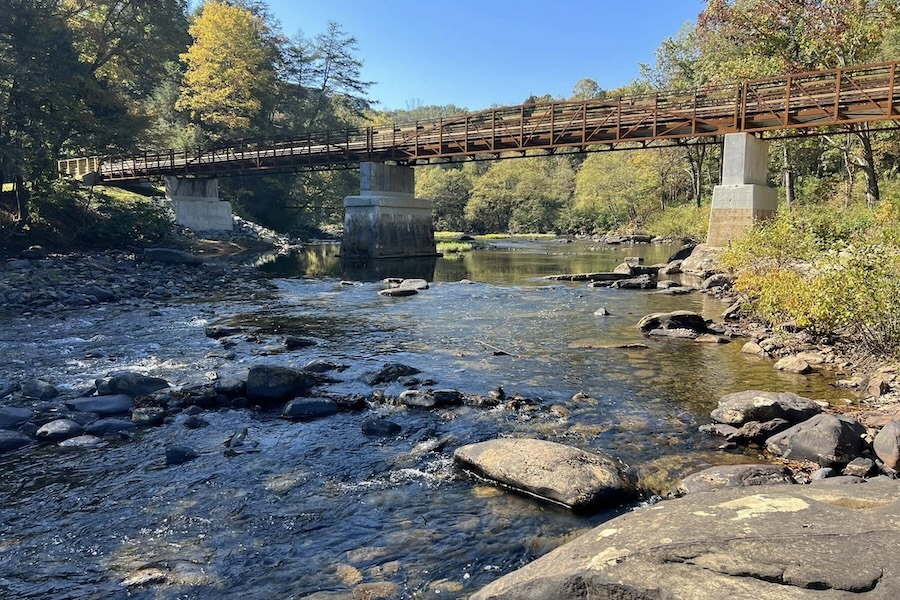
Davis is excited to see the trail as a kind of springboard for accessing the plethora of outdoor activities that the region offers. “I’ve heard the phrase that ‘Outdoor recreation tourism is the red carpet to residency.’ We want people to come here and say, ‘Wow, this is so much fun. I can see myself living here.’”
Best Is Yet to Come


Another legacy of the area’s deep connection to extraction industries is a federal funding source that aims to remediate its effects on the land and its people. The construction of the trail to Rainelle is being funded by a $2.3 million grant from the Abandoned Mine Lands Economic Revitalization program; another $500,000 from the Environmental Protection Agency’s Brownfields program will support the conversion of a former landfill into a vibrant park adjacent to the trail that offers river access points and an RV campground.
“The railroad was used to transport coal from the mines that are still scattered all over the area,” said Ford. “And the money from that federal program can be used to reclaim an old abandoned mine property, or it can be used on projects that spur economic development in the communities that surround those former mine lands—so the rail-trail hit on both.”
Additionally, just last month, a $3.2 million grant from a congressionally directed spending request made by U.S. Sen. Jim Justice was announced, which will be used to develop the section going up to the Gauley River National Recreation Area. An additional $739,000 has also been approved from the Federal Lands Access Program.
“We’re well acquainted with the economic impact of trails and rail-trails, so we know that it’s worth going after that kind of funding,” explained Davis. “We don’t have dedicated funding for trails at the state level in West Virginia, so federal dollars, including Transportation Alternatives and the Recreation Trails Program, are really some of the only major funding sources that are reliably available for these projects.”
The growing momentum for the project is almost palpable. “The Meadow River Rail Trail is very popular so far, but currently, it’s kind of one of those trails that just stops in the woods,” said Davis. “So knowing that there are plans to continue the trail farther and to connect it into additional river access points and trailheads and parks, it’s a feeling that the best is yet to come.”
Related Links
Trail Facts
Name: Meadow River Rail Trail
Used railroad corridor: The trail follows the former route of the Fayette, Nicholas & Greenbrier Railroad built in 1907 and later owned by CSX.
Trail website: Meadow River Rail Trail
Length: 11 miles
Counties: Fayette, Greenbrier
Start point/end point: WV 41/Wilderness Hwy., near the Nallen Post Office (9001 Wilderness Hwy, Nallen) and dead-ending with no road access at the Meadow River Bridge (8 miles north of Rainelle)
Surface type: Crushed stone
Grade: Fairly level; nominally uphill heading south from the Nallen trailhead
Uses: Walking, biking, horseback riding, fishing and cross-country skiing
Difficulty: The trail itself offers an easy experience for most users; however, note that there are currently no restroom facilities or drinking fountains available directly along the trail. Additionally, cell phone service is only available at the trailheads.
Getting there: Raleigh County Memorial Airport (176 Airport Circle, Beaver) is the closest facility, some 55 miles from the trailhead; West Virginia International Yeager Airport (100 Airport Road, Charleston), with more flight options, is about 70 miles away.
Access and parking: The northern trailhead at Nallen, adjacent to the Nallen Post Office (9001 Wilderness Hwy.), offers the largest parking lot. Additional parking is available at the Russellville trailhead (360 Quinwood Nutterville Road).
To navigate the area with an interactive GIS map, and to see more photos, user reviews and ratings, plus loads of other trip-planning information, visit TrailLink™, RTC’s free trail-finder website.
Rentals: Nearby Fayetteville, about 20 miles from the trailhead, offers bike rental options at New River Bikes (221 N Court St.; 304.574.2453) and Arrowhead Bike Farm (8263 Gatewood Road; 304.900.5501).

Donate
Everyone deserves access to safe ways to walk, bike, and be active outdoors.