Building a Trail Tourism Ecosystem
Ecusta Market & Cafe along North Carolina’s Ecusta Trail | Photo by Craig Distl, courtesy Visit Hendersonville
Explore Other Toolkit Sections
- Diving In: How To Use the Toolkit
- Advocacy for Trail Tourism
- Building a Trail Tourism Ecosystem
- Demonstrating Impact
- Funding Trail Tourism
- Developing a Regional Trail Tourism Identity
- Maintenance and User Experience
- Trail Tourism Marketing
- Organizational Capacity and Collaboration
- Fostering Stewardship and Belonging
Breaking It Down | Action Plan | What’s Next | Case Studies
Securing Support and Generating Progress
Amenities are not just about comfort; they are the bridge between a trail and a thriving local economy—the core element in building a trail tourism ecosystem. When thoughtfully planned, amenities do more than support the trail user experience. They drive visitor spending at nearby businesses; encourage longer stays and repeat visits; create demand for new businesses like café, outfitters, lodging and tour services; and have the potential to shape the identity and marketability of a place.
The most successful trail tourism communities don’t treat amenities as isolated features. They treat amenities as part of a coordinated economic development strategy that links the trail directly to critical features in the community like restaurants and food systems, retail and gear shops, lodging and overnight experiences, and local services and attractions.
In this way, a trail becomes not just a path, but a linear main street that organizes and fuels a local tourism economy.
This chapter of the toolkit outlines the role of amenities and systems integration to support a trail tourism strategy, while providing resources and tools to develop a firm understanding of existing assets across the region and a plan for what’s needed.
Defining a Trail Tourism Ecosystem
Prioritizing the development of amenities—desirable or useful features—that enhance the quality and usability of the trail experience and encourage the economic participation of residents and visitors. These include functional infrastructure (e.g., restrooms, bike repair stations, information kiosks, etc.) as well as enhancements to user experience, such as public art, interpretive signage and other features that position the trail as a destination.
Breaking It Down
Inadequate amenities and a disconnected economic ecosystem are among the biggest barriers to trail tourism. Visitors expect basic comforts such as restrooms, water, seating and adequate wayfinding. They may shorten their visit or choose another destination if those needs aren’t met. Even when those basics are in place, many communities still fail to capture economic value from the trail because trails are physically disconnected from business districts; visitors don’t know where to go or what’s nearby; businesses don’t exist or are not oriented toward trail users (e.g., hours, signage, services); and there is no coordinated “trail-to-town” experience.
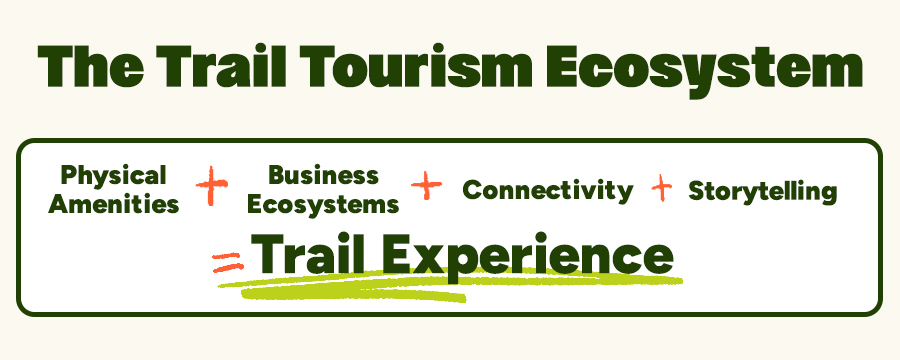
Even when communities plan for the amenities needed to support successful trail tourism, if the trail isn’t considered as part of a larger system, the chance to maximize economic value—and the trail tourism experience—will be limited.
When communities get this right, the outcomes are tangible—everything from increased per-visitor spending; growth in hospitality and retail sectors; the emergence of trail-oriented businesses (e.g., bike shops, cafés, shuttle services); and stronger community buy-in and long-term sustainability.
Core Strategy
Prioritize amenities that enhance comfort, safety and exploration while aligning with your trail’s identity and tourism goals.
Making It Actionable
The following outlines a plan of action to build a trail tourism ecosystem and maximize the economic and social value that the trail promises.
1. Start With Essential Comfort and Safety Amenities
Visitors are more likely to stay, explore and return when their basic needs are met and while more advanced features, like e-bike charging, can be exciting, it’s important to first prioritize the essentials.
Examples of essential comfort and safety amenities to explore in your community include restrooms; water fountains or refill stations; benches, seating and shade structures; trash and recycling bins; lighting where appropriate; trailhead kiosks with maps and points of interest; trail markers and basic wayfinding; well-located bike racks; convenient vehicle parking at key trailheads; signage with emergency contact information; and safety warnings for at-grade road crossings. In addition, basic amenities can easily be enhanced with bike repair stations, printed trail maps, signage at road intersections with road names, and coordinated signage at regular intervals confirming that users are still on the trail.
Some amenities may require multi-agency coordination, long-term maintenance commitments and funding sources that are difficult to secure. As a result, many trails struggle to provide even the basics. Collaboration can often help communities make progress on amenities more quickly. Consider what opportunities exist to educate trail visitors about nearby businesses, services and amenities. What may seem like a small touch can go a long way to build awareness of potential visitors and residents about the intersection of the trail with the community.
In addition, co-locating amenities with businesses can reduce public cost, drive customers directly to businesses and build early buy-in from the private sector. Options exist beyond independently building all amenities on the trail. For example, think about partnering with local cafés, breweries or shops to provide restrooms and water; encourage business-sponsored bike racks and seating areas; or implement wayfinding signage to direct users to nearby services.
One place to start is to honestly assess the amenities that your community or region already offers, and those that are needed. Many resources exist to support your efforts to develop an asset inventory:
- The Progress Fund’s Trail Town Assessment helps communities evaluate their trail, their downtown area and their visitor-serving assets. Evaluated assets include restrooms, signage and access to restaurants, lodging and bike services. The assessment provides a practical framework for identifying gaps and strengthening a connected trail tourism ecosystem.
- A strong example of a destination inventory can be found in the Lower Rio Grande Valley Active Transportation and Active Tourism Plan, specifically page 164 (Appendix C: Tourism Destinations by Category). This section offers a clear model for organizing and categorizing local assets to better understand and promote a region’s tourism offerings.
- The Main Street Approach™ offers a flexible and widely used framework for strengthening commercial districts. It includes guidance on placemaking and public space design, along with tools to support small businesses and entrepreneurs, such as strategies for activating vacant storefronts with trail-oriented retail.
- Developed for British Columbia, Canada, the Western Mountain Bike Tourism Association’s guide provides valuable, transferable strategies for building trail-based tourism economies. The guide includes tools for developing events such as races and festivals that drive visitation during shoulder seasons, guidance on destination branding and approaches to long-term, sustainable tourism planning.
- The Adventure Cycling Association’s Bicycle Tourism Toolkit includes templates for business outreach, tourism development strategies and route-based economic planning.
- The Outdoor Recreation Roundtable’s Rural Economic Development Toolkit “seeks to provide strategies for success sourced from communities around the country to achieve intersecting goals: healthy communities, high quality of life, robust businesses, resilient economies, and vibrant outdoor places.”
- The Erie Canalway National Heritage Corridor’s guide, Attracting Bike Tourists to your Trail: Lessons from the Canalway, can be used like a checklist of considerations and features communities can offer to better serve trail tourists. The guide discusses amenities including maps and route descriptions, well-marked routes and destinations, convenient lodging, eating establishments, parking, restrooms and more.
- The Allegheny Trail Alliance’s Trail Town Manual offers guidance to understand your trail town customers, assess trail user needs, plan for organizations and businesses to meet those needs, encourage trail-related business opportunities and assist the local business community.
- The Michigan Trail Towns Guide presents criteria that communities can adapt to develop a sustainable marketing plan and a cohesive “trail-to-town” experience. Follow the guide’s “Four Point Approach” (Organization, Design, Economic Restructuring, Promotion) to align business offerings with trail branding.
- Kentucky Trail Towns: A How-to Guide for Communities provides guidance on evaluating your community’s provision of basic trail user needs, encouraging trail tourism businesses, promoting a “Trail Town” image, holding events, and creating a sense of place.
- The North Country Trail Association’s Trail Town Handbook offers tools and resources for local officials, business owners and trail leaders and coalitions to create a visitation environment that is tailored to trail users.
Amenities and Economic Opportunity
Use this table to assess physical trail amenities and your community’s ability to support trail users through local businesses, food options and lodging. Together, these elements define the trail tourism ecosystem that drives spending, supports entrepreneurship and encourages overnight stays. This table can serve as a jumping-off point for creating an asset inventory.
| Category | Amenities and Businesses to Consider | What it Delivers | Economic Development Opportunities |
|---|---|---|---|
| Comfort | Restrooms, water, shade, seating, lighting, cleanliness, nearby cafés, coffee shops, indoor seating, Wi-Fi locations | Comfort determines whether visitors stay for 30 minutes or several hours. | Comfortable environments encourage lingering, which increases spending at nearby businesses. Opportunities for cafés, bakeries and small retail establishments to cluster near trail access points. |
| Access | Trailheads, parking, ADA access, transit connections, clear entrances, visible and direct connections to downtowns, business districts and commercial corridors | Easy access reduces friction and increases likelihood of visitation and repeat use. | Strong physical and visual connections drive trail users directly into business districts. Supports retail, services and mixed-use development near trail corridors. |
| Rest | Benches, picnic areas, shelters, hydration stations, grab-and-go food, food trucks, convenience retail, farmers markets | Places to pause can extend trip duration and make visitors’ experience more enjoyable. | Trails create demand for quick-service food and flexible vendors. Ideal for small businesses, pop-ups and seasonal entrepreneurs to serve trail users. |
| Exploration | Wayfinding, maps, interpretive signage, public art, connections to parks and attractions, signage and marketing that highlight local businesses, restaurants, breweries, shops and cultural destinations | Clear wayfinding encourages users to leave the trail and explore the community. | Guiding users to businesses and experiences directly drives visitor spending. Supports development of branded districts (e.g., trail towns, arts corridors, brewery trails) and increases visibility of local entrepreneurs. |
| Safety | Lighting, maintenance, safe crossings, visibility, emergency features, active commercial areas, open businesses, “eyes on the trail” | Safety is essential for attracting a broad range of users, including families and tourists. | Safe, active environments increase foot traffic and investor confidence. Supports longer operating hours for businesses and strengthens the market for trail-adjacent development. |
| Integrated Across All Categories: Overnight and Extended Stay | Lodging options near the trail: hotels, inns, bed-and-breakfasts, campgrounds, short-term rentals, bike-friendly accommodations (storage, repair tools, laundry) | Comfortable lodging options enable multiday visits and higher overall spending. | Overnight visitors spend significantly more than day users. Lodging is a cornerstone of trail tourism economies and supports restaurants, retail and service businesses across the community. |
Action Item:
Create an amenity “wish list.” Identify which amenities already exist, which are missing and which could be added or improved in the next 12 months. If a trail does not yet exist, consider which amenities should be incorporated early in the planning process and which should wait until a later stage.
2. Think About Broader Connectivity
Amenities and infrastructure that connect visitors to local businesses and attractions strengthen the economic impact of trail tourism. By providing convenient access and appealing opportunities for rest, resupply and exploration, amenities encourage visitors to spend more time , and ultimately more money, in the surrounding community. This integration strengthens the symbiotic relationship between the trail experience and the local economy, turning a recreational visit into a significant economic impact that benefits a wide range of local enterprises, from small restaurants and retail shops to lodging providers and service-based businesses.
Examples of broader connectivity include:
- Bike racks, bike-share stations and secure bike parking at trailheads and downtown areas
- Wayfinding to dining, lodging, parks and historical sites
- Safe crossings, sidewalks and ramps
- Trail-to-town portals or gateway signage that connects the person on the trail to businesses, amenities and services in the community
- Trail-Friendly Business program, that creates a relationship between local businesses and trail visitors
Action Item:
Map 5 to 10 points of interest that are in proximity to your trail or potential trail corridors (e.g., restaurants, shops, parks). Identify any barriers that prevent visitors from accessing these places. Think about how you might address one barrier in the next 12 months.
3. Close Network Connectivity Gaps That Limit Visitor Experience
Physical connectivity determines how easily people can access and navigate the trail and move between towns, trailheads and attractions. Many trails lack safe or intuitive connections to nearby neighborhoods, main streets, transit stops or other trail segments. Gaps between trail segments, high-traffic road crossings, underdeveloped linkages and uneven trail quality can deter visitors and limit the tourism potential of an entire corridor. Such gaps interrupt movement, create safety issues and reduce the appeal of long-distance trips. Addressing these missing links is essential to developing a continuous, enjoyable and profitable trail ecosystem.
Where to focus:
- Neighborhood access: sidewalks, crosswalks, lighting, clear signage
- Trail-to-town linkages: wayfinding, branded routes, distance markers
- Cross-jurisdiction gaps: states, cities, counties, park districts, easements, negotiated access
- Transit access: bus stops, park-and-ride lots, mobility hubs, bike-share stations
- Safe crossings: signage, stop controls, separated pathways
- Universal design features: curb cuts, graded surfaces, ramps
Physical connectivity directly influences who uses the trail, and how often. Improving network linkages increases local participation, builds visitor confidence and enhances the trail’s attractiveness as a tourism asset. Continuous connectivity encourages longer stays and increases the economic benefit to the communities along the trail. Even simple improvements can dramatically increase trail use.
| Common Gap | Strategies to Close the Gap |
|---|---|
| Missing trail segments | – Conduct a corridor-wide connectivity audit to identify priority gaps. – Use data (usage, demand, safety concerns) to strengthen funding proposals. – Pursue phased development and deploy interim routes (signed on-road connectors). |
| Disconnected wayfinding systems | – Develop shared signage standards and templates with community partners, which could include local businesses and municipal leaders – Install temporary or low-cost signage until permanent signs are funded. – Coordinate with tourism partners to unify printed or interactive digital maps (e.g., the Ecusta Trails digital interactive map). |
| Inconsistent maintenance across jurisdictions | – Establish a shared maintenance agreement or expectations document (e.g., Memorandum of Understanding for Maintenance of Trail System between City of Columbus, Ohio, and Franklin County, Ohio). – Schedule joint seasonal maintenance days. – Use volunteer groups or Adopt-a-Mile programs to fill gaps. |
| Uneven trail quality | – Prioritize improvements where surface changes reduce safety or accessibility. – Use signage to set expectations (e.g., “Surface changes ahead”). – Seek multijurisdictional grants focused on ADA accessibility or active transportation. |
| Lack of water, restrooms or safety features | – Identify low-cost amenities (e.g., portable toilets, temporary shade, pop-up water stations). – Explore public-private partnerships. – Use data and user stories to advocate for permanent infrastructure. |
| Missing bike parking or staging areas | – Install low-cost racks or fix-it stations near trail-to-town entrances. – Partner with local businesses to host racks or secure storage. – Use sponsorships (e.g., local banks, health care systems) to fund installations. |
| Incomplete digital maps or trip-planning tools | – Update basic trail information on commonly used platforms such as TrailLink. – Coordinate with regional partners to create a shared map or digital guide. – Add QR codes at trailheads linking to maps, park hours and itineraries. |
Action Item:
Identify your trail’s top three barriers to access (e.g., unsafe crossing, missing sidewalk, unclear signage) and identify the individuals and organizations that have domain over the barrier. Use strategies covered in the “Advocacy” and “Demonstrating Impact” chapters of the toolkit to compel action toward addressing these barriers.
4. Add Value-Added Amenities That Create a Memorable Experience
Once basic amenities are in place, consider features that make your trail distinct and interesting to others. These types of features are at the core of creating a memorable experience for visitors and residents—and can often become defining features for the region. For example, amenities like public art, murals and other creative installations; interpretive signs about history, ecology and culture; lookouts, photo spots and branded landmarks; picnic areas and food truck parks; and seasonal elements like flower plantings or pop-up installations can help define a trail’s brand and encourage visitors to stay longer, take photos and return with friends.
RTC’s resources on planning public art, gardens and events are great places to further explore strategies to develop signature visitor experience. Also consider the resources at the Citizens’ Institute on Rural Design for case studies on creative placemaking.
Action Item:
Identify one location along the trail that could easily become a signature visitor experience. Brainstorm three enhancements to activate it.
5. Get Creative
Even at the earliest stages of trail development, integrating amenities that are low-lift, low-cost and short-term can help to build the expectation for future trail tourism. For example, consider temporary signage, a trailhead kiosk made of hay bales or a partnership with local artists to create temporary art installations. For example, RTC uses inexpensive yard signs for its annual tour along the Great American Rail-Trail®. It visually helps riders know that they are on the right path while also being helpful leave-behinds for the community to know they are part of an ongoing effort to connect a trail across the country.
A seasonal amenity is likely easier to plan for and manage than something meant to be permanent. Temporary amenities have the added benefit of allowing you to test ideas and gauge users’ reactions before investing in permanent installations.
Action Item:
Explore resources and tools that can help you with a low-lift, high-impact amenity. For example,Better Block’s guides can help you set up temporary pop-up installations (e.g., murals, seating, pergolas and more) to test viability at trail-to-town intersections. Wikiblock is an open-source design library that includes designs for benches, chairs, planters, stages, bus stops, beer garden fences and kiosks.
What’s Next?
The following are suggested next steps for amenity planning, organized by trail tourism readiness level. Use the “Trail Tourism Readiness Assessment” tool to identify the phase that aligns with your community.
In Development
Conditions: Towns along your trail (or prospective trail) have no or few visitor amenities.
Amenities Focus: Prioritize predictable, safe places for visitors to begin using early sections of the trail.
Next Steps:
- Focus on low-cost essentials like temporary signage, portable restrooms and simple seating.
- Develop an amenities vision map that identifies future trailheads and comfort features.
- Coordinate with municipal partners early to clarify responsibilities.
- Install one small but visible comfort amenity to build community buy-in. This can make the trail easier to build and fund in the future.
- Begin exploring funding options for long-term amenity development.
Local Favorite
Conditions: Your trail may lack value-added amenities such as bike repair stations and information kiosks. Your trail serves locals, but lacks visitor-ready linkages to businesses providing food, water, bike shops, etc.
Amenities Focus: Strengthen core amenities and make nearby businesses easier to find and use, laying the groundwork for local economic activity and future visitor growth.
Next Steps:
- Add essential amenities such as water access, bike racks, seating, shade and rest areas to improve comfort and usability.
- Install clear wayfinding and signage that directs users to nearby businesses, parks and services within a short distance of the trail.
- Prioritize one or two high-impact trailheads or downtown access points for enhanced amenities like kiosks, maps or interpretive elements.
- Establish maintenance partnerships with local governments, nonprofits or adjacent businesses to ensure amenities remain clean, safe and functional.
- Conduct a simple user and asset assessment to identify gaps. Consider what users need, what already exists and where small investments can unlock economic activity.
Regional Destination
Conditions: Your trail has some amenities and enough food and lodging options to attract users from beyond the local community, but does not yet offer the robust variety of amenities that would attract a wider audience. Some amenities need to be refreshed.
Amenities Focus: Look at trail-related amenities through the lens of multiday trips and repeat visitors.
Next Steps:
- Improve trailhead areas with better signage, shade and branded information. Create a plan for consistent branding across all kiosks and signage.
- Upgrade or repair aging amenities to improve user satisfaction.
- Add one signature or scenic amenity to elevate the trail experience.
- Create a 5-year amenity build-out plan identifying the necessary funders and partners who need to be involved to achieve the desired outcomes.
- Offer itineraries featuring different distances, destinations and difficulty level. (We love the variety of itineraries for the Circuit Trails in the Greater Philadelphia and southern New Jersey region.)
National Destination
Conditions: Your trail (or trail network) has amenities that elevate the overall user experience, facilitate multiday trips and serve as a draw for visitors from outside of the region or state.
Amenities Focus: Ensure that amenities are well cared for and that future needs are being planned for.
Next Steps:
- Invest in premium experiences such as overlooks, public art or visitor centers.
- Integrate amenities into regional marketing and itineraries.
- Ensure all amenities meet national accessibility and safety best practices.
- Expand visitor services (e.g., shuttles, rest stops, water access, seasonal pop-ups).
- Use advanced data tools to evaluate amenity usage and plan enhancements.
Case Studies
Connecting States and Creating Moments Along the Bob Kerrey Bridge
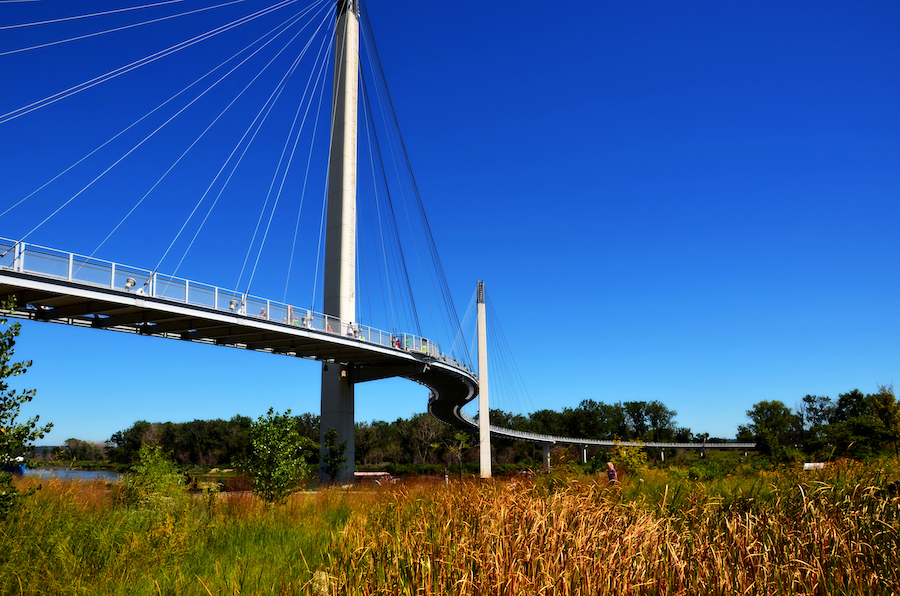
A premier case study in location-based branding, the Bob Kerrey Pedestrian Bridge provides a critical connection and crossing point over the Missouri River between Omaha, Nebraska, and Council Bluffs, Iowa. The bridge also boosts tourism through unique, shareable moments. Omar the Troll’s statue sits underneath the bridge, encouraging interaction and a reason to visit, complete with QR-coded signage to help visitors interact with Omar through active social media tagging. A painted line marks the Nebraska–Iowa border in the center, creating a popular photo opportunity for standing in two states simultaneously. The bridge even has a children’s book written about it. The marketing campaign for this landmark aims to bring life to the riverfront, tell the city’s story and create a viral “must-see” experience.
As you plan for infrastructure that enhances connectivity, safety and visibility, consider engaging your community’s creativity to transform signage, gateways and crossings into memorable, sharable tourist experiences.
Leveraging a Short-Term Pop-Up to Create High-Value Experiences in Lancaster, Pa.
Lancaster, Pennsylvania’s Prince Street Pop-Up Park transformed a disused parking lot into a temporary park featuring seating, food trucks and container gardens for the summer season.
The delayed redevelopment of a building in downtown Lancaster would have left a vacant parking lot in a major pedestrian corridor to sit idle for an entire summer season. Rather than letting the lot go unused, the city worked with developers to activate the space with temporary structures and food trucks to create the Prince Street Pop-Up Park. Open June through September, the park featured coffee and ice cream vendors, temporary lighting and seating, and wooden pallets turned into tiered flower boxes. This low-cost, low-impact solution allowed the space to remain active and vibrant while providing community space and supporting local businesses.
Especially when planning for a trail that is in development or not yet fully complete, start out by identifying parcels along the route that are underutilized or in transition. If you get creative, you can activate and beautify those spaces in ways that demonstrate the area’s future potential and elevate visitors’ experience.